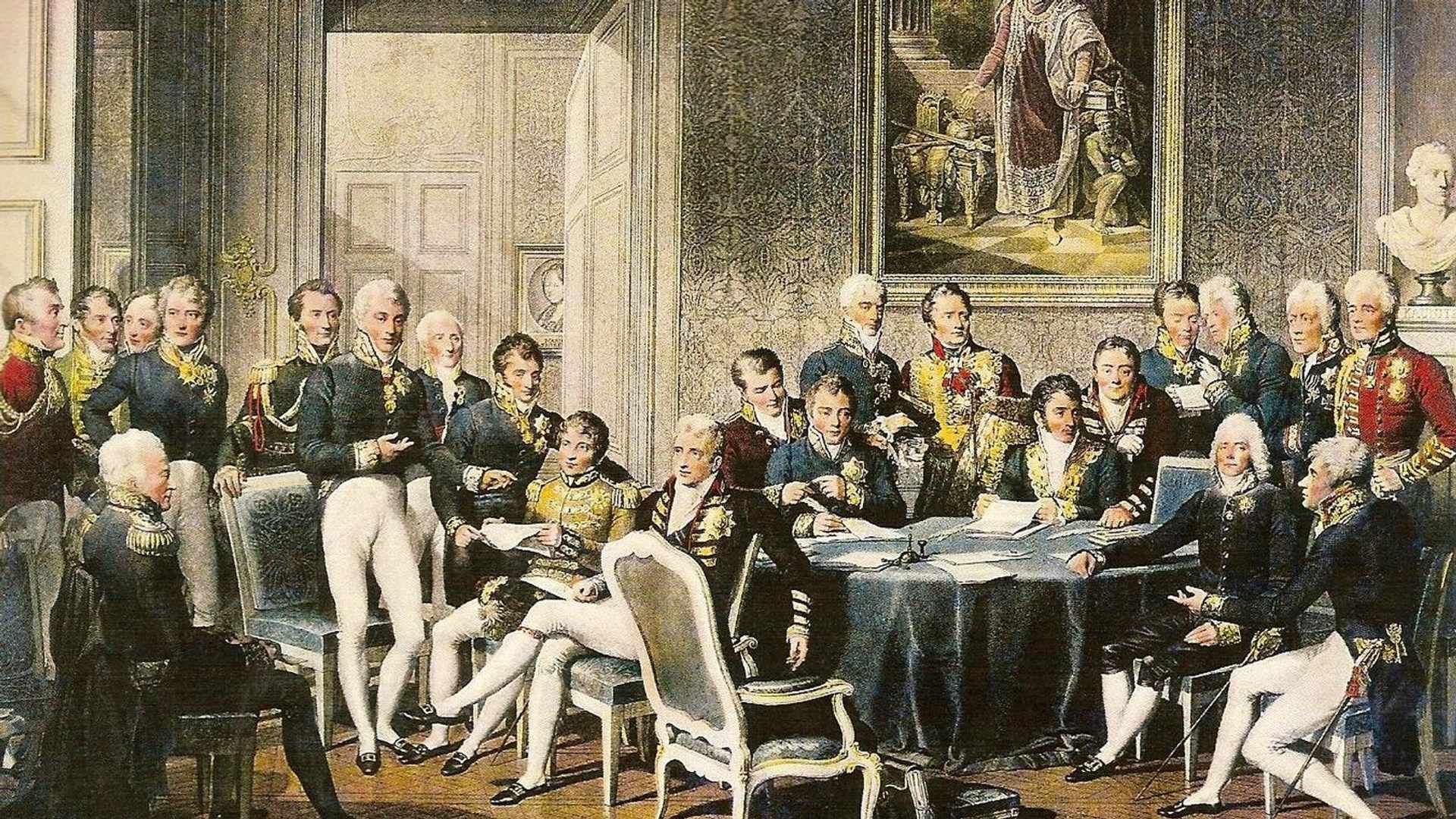
Delegates of European powers having political discussions at the Congress of Vienna, in an engraving by Jean-Baptiste Isabey. Public domain image.
The Congress of Vienna (1814-1815) was a series of diplomatic meetings held at the end of the Napoleonic Era. At the time, European states were recovering from years of war and from rule by Napoleon’s relatives and allies. Those states reasserted their independence and had to organize the continent in a way that made lasting peace more likely. With this goal, they gathered in the capital of Austria with principles, diplomatic leverage, and the authority to reshape Europe. Their deliberations changed the map of the continent and set the stage for a period of great-power politics known as the Concert of Europe. For this reason, the Congress of Vienna became a key event in nineteenth-century history.
Participants of the Congress and Their National Interests

From left to right, the representatives of the major European powers at the Congress of Vienna: Metternich (Austria), Castlereagh (United Kingdom), Alexander I (Russia), Hardenberg (Prussia) and Talleyrand (France). Public domain images.
The Congress of Vienna was attended by many diplomats, foreign ministers, and heads of state from European countries. The discussions were dominated by five powers that shaped the final settlement. Austria and the United Kingdom negotiated alongside Russia, Prussia, and France. These were their leading representatives and the national interests they defended:
- Foreign Minister Prince von Metternich (Austria): According to Henry Kissinger, he was the main architect of the Vienna order. His “consummate skill was in inducing the key countries to submit their disagreements to a sense of shared values”. In doing so, he sought to maintain Austria’s political hegemony and a balance of power in Central Europe.
- Foreign Secretary Viscount Castlereagh (United Kingdom): He sought to prevent France from regaining its status as a dominant continental power and to contain Russia’s aspirations. Britain wanted the continental powers to remain at peace and in equilibrium with one another, preferably while respecting the wishes of smaller states. At the same time, it wanted to protect British hegemony over overseas colonies, industrial interests, and maritime trade routes.
- Tsar Alexander I (Russia): He was a conservative monarch who championed absolutism and wanted to combat any threat of revolution or republicanism. During the Napoleonic Wars, he had briefly considered refashioning Europe in liberal and constitutional terms, but he soon resumed his authoritarian tendencies. In Vienna, he wished to take control of Poland, expand Russian territory, and establish Russia as a major land power.
- Chancellor and Prince Karl August von Hardenberg (Prussia): Aware of the historical rivalry between Austria and Prussia, he wanted to secure Prussia’s position in the lands of the former Holy Roman Empire. In particular, he wanted to annex all of Saxony and parts of the Ruhr.
- Foreign Minister Talleyrand (France): He had been Napoleon’s right-hand man in international affairs, but he remained in office after King Louis XVIII came to power. His goal was to prevent France from being demoted to a second-rank power or dismembered by the occupying powers. However, the king distrusted him and also conducted separate negotiations with other states.
The Congress was a negotiation among powers with unequal military strength, diplomatic prestige, and territorial ambition. Smaller states could present claims, and some dynastic interests were heard. The final architecture depended on compromises among the major powers. The hardest bargains concerned Poland and Saxony, France’s future status, and the security of Central Europe.
This balance between hierarchy and consultation helped define the Vienna method. Formal sessions mattered alongside private conversations, social gatherings, bilateral bargaining, and informal pressure. The Congress became famous for its balls and ceremonies, and those rituals also served political purposes. They created spaces in which diplomats could test proposals, soften rivalries, and avoid turning every disagreement into a public rupture. Diplomacy itself became part of the postwar order, giving the powers a way to manage disputes before they turned into military crises.
Principles of the Congress
During the Congress of Vienna, certain principles guided the deliberations of the European powers and were accepted as a framework for rebuilding the continent after the wars. The settlement combined dynastic restoration, territorial compensation, balance of power, and conservative intervention against revolution. These were the main principles of Vienna:
- Legitimacy: The French Revolution and the Napoleonic Wars had dethroned several absolutist dynasties and replaced them with other monarchs. After the defeat of the revolutionaries, Talleyrand wanted Louis XVIII to keep the French throne, so he proposed the principle of legitimacy. Under this principle, dynasties that had ruled Europe before the Revolution were legitimate and should be restored to power.
- Compensations: During the revolutionary period, France had taken control of many territories. The victors treated those occupations as losses that needed compensation, so occupied lands were to be redistributed among Europe’s powers.
- Equilibrium: The map of Europe would emerge from the settlement in a new form. Redistributed territories would be assigned with the aim of narrowing power differences among the major countries. If every European power were satisfied with this settlement, another general war would be less likely.
- Interventions: Because the settlement treated the absolutist regimes of pre-revolutionary Europe as legitimate, attempts to oust them had to be resisted. After Vienna, Austria, Prussia, and Russia formed the Holy Alliance to suppress new revolutions, while the United Kingdom preferred to remain outside that project. Some historians have treated the alliance as more self-interested than altruistic.
These principles created real tensions. Legitimacy favored the return of old dynasties; compensation and equilibrium required territorial adjustments that ignored some local wishes. The result was a conservative settlement that revised the pre-1789 map. The powers aimed to prevent a renewed French bid for dominance, limit revolutionary contagion, and reward the states that had done most to defeat Napoleon.
For that reason, Vienna mixed ideology with calculation. Its diplomats defended monarchy and hierarchy while acting from strategic interest. A restored Bourbon France could be reintegrated into European diplomacy, making an intact France more useful than a permanently excluded one.
Main Decisions of the Congress
In Vienna, the five major powers of Europe agreed upon a series of measures intended to craft a new international order in the continent.
Thanks to the work of Talleyrand, France avoided territorial partition and remained one of Europe’s great powers. Its territory would be slightly larger than it had been before the Revolution. The French also had to pay war reparations, and until those payments were completed, parts of the country would remain temporarily occupied by the victors’ troops.
Most decisions in Vienna revolved around territorial redistribution that favored France’s wartime opponents and limited French influence. These were the main territorial changes:
- During the last phase of the French Revolution, Switzerland had been overrun by the revolutionaries and turned into the Helvetic Republic, a vassal state. Napoleon eventually had to reestablish the Swiss Confederation, but the country remained dependent on France. In Vienna, Switzerland would be restored as a fully independent and neutral country, and Europe’s powers would guarantee its neutrality.
- Napoleon had created the Duchy of Warsaw in the region of current-day Poland. This entity was abolished and its territory was split between Austria, Prussia and Russia.
- Napoleon had created the Confederation of the Rhine in the region of current-day Germany. This entity was replaced by the German Confederation, which tied German politics to Austrian influence and Prussian economic weight. The goal was to prevent France from becoming a hegemonic power in Central Europe.
- Prussia would acquire the Rhineland and part of Saxony, two regions with major economic and strategic value.
- Russia would acquire Bessarabia, in present-day Moldova and Ukraine, and keep the Grand Duchy of Finland, which it had taken from Sweden in 1809.
- To compensate Sweden for losing Finland, the Swedes would acquire Norway, a region that had belonged to Denmark, a French ally. The Norwegians rejected this settlement and fought a brief war, but they were ultimately defeated and forced to accept the rule of the king of Sweden. According to historian Eric Hobsbawm, this arrangement favored the United Kingdom because two states would share control over the Baltic Sea. The arrangement remained contentious until the Swedish-Norwegian union was dissolved in 1905.
- The United Kingdom took possession of certain colonies from the Netherlands, because the Dutch had been French allies. These included the Cape Colony in South Africa, Ceylon in present-day Sri Lanka, and part of Guiana.
- To compensate the Dutch for losing these colonies, they would acquire Belgium, then the Austrian Netherlands, because Austria had been a French ally. This territorial exchange created the United Kingdom of the Netherlands as a northern barrier against France.
- To compensate Austria for losing Belgium, it would acquire certain territories in the Italian Peninsula. The pope would also regain control over territories in the same region.
Regional Logic of the Settlement
The territorial settlement created buffer zones around France and strengthened states expected to contain future French expansion. The United Kingdom of the Netherlands guarded France’s northern frontier, Prussian gains in the Rhineland placed a military power on the western edge of Germany, and the Swiss guarantee removed one strategic route from ordinary great-power competition. These choices made the settlement preventative as well as punitive.
In Central Europe, the German Confederation replaced Napoleon’s Confederation of the Rhine without recreating the Holy Roman Empire. This arrangement left German lands divided, gave Austria a framework for influence, and allowed Prussia to grow in economic and military importance. In Italy, restored rulers and Austrian influence limited revolutionary and nationalist movements and left intact political tensions that would later feed unification movements.
The regional logic of the settlement tied local borders to continental security. The Polish and Saxon disputes shaped the balance between Russia and Prussia. In the west, the Low Countries and Switzerland served the containment of France; in Central and Southern Europe, German and Italian arrangements served it in another way. This approach gave the settlement coherence, but it also meant that many communities received new rulers, diplomatic status, or constitutional limits without direct political consent. Vienna therefore stabilized Europe by treating regional politics as part of the same great-power problem. The result was not neutral cartography; it was security policy drawn onto the map.
Slave Trade Declaration and Diplomatic Limits
In addition to these territorial adjustments, the powers attached a declaration against the slave trade to the final settlement:
- The slave trade was condemned as contrary to humanitarian principles. Its actual abolition would still come only after years of pressure and resistance from countries and economic interests that depended on slavery, including Brazil.
The declaration against the slave trade showed that the Congress could attach moral language to diplomacy without guaranteeing quick, practical, or uniform international enforcement. Britain had already abolished its own slave trade and used naval power and diplomacy to press other states; many governments still moved cautiously. It also made abolition a subject of international diplomacy rather than only domestic reform. In that sense, the final act widened the vocabulary of international politics while leaving most coercive decisions to later governments. The issue revealed the limits of Vienna’s conservatism: it could condemn some practices while preserving colonial empires and social hierarchies.
Conclusion: European Order after Vienna
The Congress of Vienna began when Napoleon seemed defeated and had been sent into exile on the island of Elba. While the powers convened, he escaped, returned to France, and briefly challenged his adversaries before being defeated for the last time and sent to Saint Helena. With Napoleon removed from power, Europe’s monarchs, foreign ministers, and diplomats proceeded to design a new order in which great-power politics prevailed. The Vienna settlement inaugurated the Concert of Europe, a period of peace among the major powers based on consultation among the five leading states. The system preserved rivalry and repression while leaving nationalism and revolution unresolved. By turning consultation into a recurring practice, it gave the major powers a shared interest in preventing another continent-wide Napoleonic conflict.
The settlement therefore worked less as a final peace treaty than as a framework for managing disputes among the strongest states. It helped delay another general European war, but it also treated national and liberal claims as problems to be contained rather than political demands to be answered. That compromise explains both the durability of the Vienna order and the revolutions and wars that were eventually needed to overcome it. Its legacy was institutional as much as territorial: regular diplomacy became part of the settlement itself, even when the settlement denied representation to many Europeans. Its success and its limits came from the same source: the powers preferred managed stability to popular self-determination.