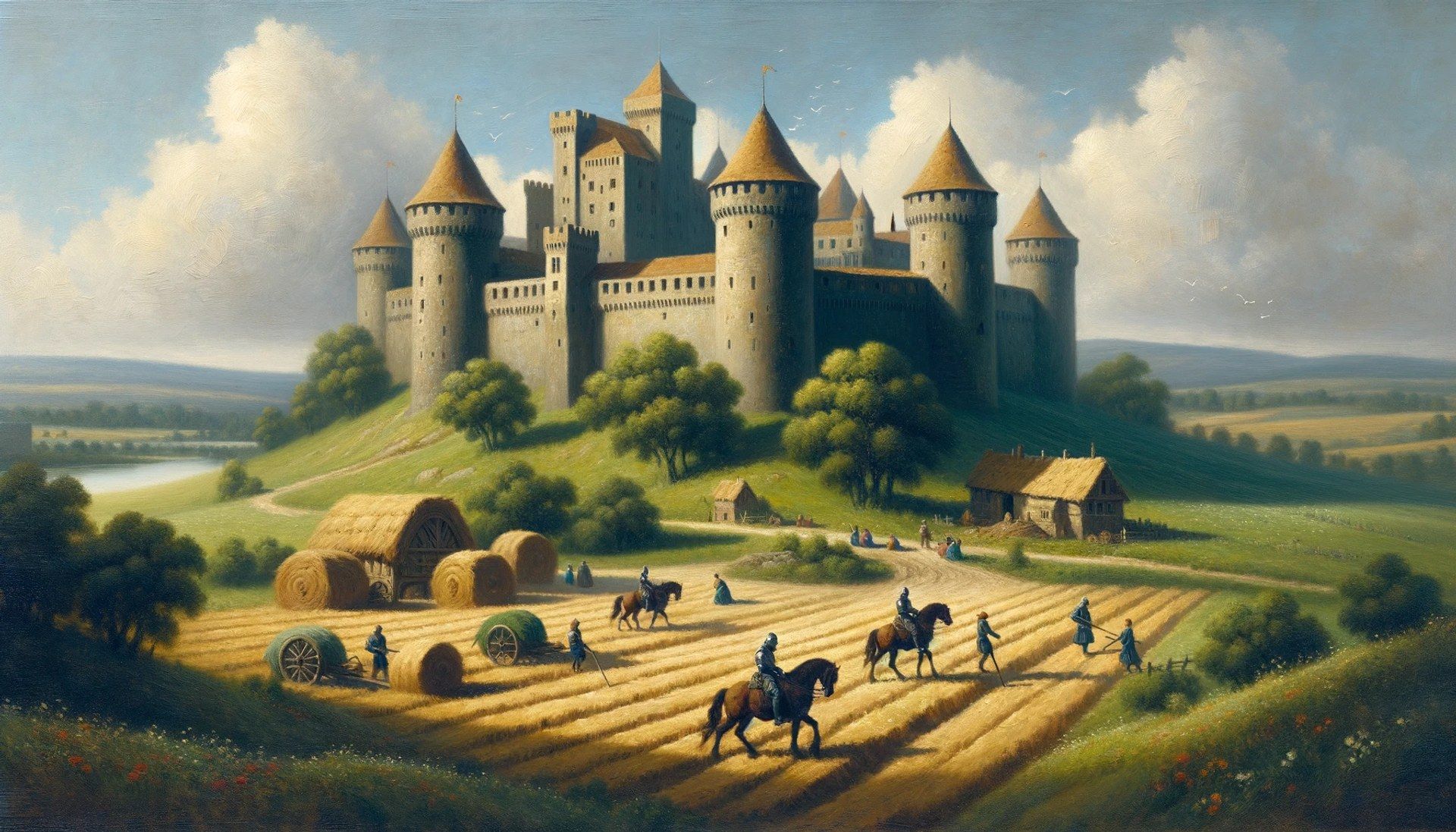
A feudal castle and its grounds that are being cultivated by peasants and patrolled by knights — a common landscape during the Middle Ages. © CS Media.
In medieval Europe, feudalism was a political, economic, and social system that existed between the 9th and 15th centuries. Its name comes from the Latin word “feodum” or “feudum”, which was used during the medieval period to describe a fief — a piece of land held in exchange for service or labor. The feudal system revolved around a series of allegiances and obligations between the people who owned land, directly or indirectly, and those who worked for them.
It developed as a way of organizing authority in a fragmented world where kings were often distant, roads were unsafe, and armed local elites controlled the resources that most people needed to survive. A peasant might experience feudalism less as an abstract political order than as the daily reality of owing labor, rents, and obedience to a lord who controlled land and protection.
Origins of the feudal system
The Roman Empire had been a dominant force in Europe for centuries, but it was hard to control and it split into two: the Eastern Roman Empire and the Western Roman Empire. The eastern half endured longer, while the western half began to weaken due to internal strife, economic decline, and invasions by barbarian tribes. These were tribes that didn’t speak Latin and that lived on the outskirts of the Empire. They began to attack the Roman borders and made their way to Rome and other major cities.
Because of the invasions, the Romans were forced to leave their homes and had to move on. In many cases, they went from towns to rural areas, looking for both safety and work. They found these in the fiefs: agrarian properties that were surrounded by tall and strong walls, where peasants were employed by a landlord to work on his land or on his castle. Eventually, many such fiefs emerged, and Europe’s population began to fall under the feudal lords’ control.
This shift did not happen overnight. The old Roman habits of taxation and centralized administration faded unevenly. Urban life contracted in many places, and powerful families, church leaders, and warriors filled the vacuum left by imperial weakness. In some regions, a large estate became the most dependable place to find food, justice, and armed defense. For people who feared raids or hunger, entering a lord’s domain could seem safer than remaining legally free but physically exposed. That practical search for security helped turn private estates into centers of public power.
The three estates of feudal society
At the time, European society adopted the “estate system”. This worldview separated those who prayed from those who fought and from the common people who worked the land.
The clergy was comprised of the representatives of the Holy Roman Church, who were in charge of religious ceremonies and the expansion of Catholic faith. They made allegiances with political leaders, even barbarians, to make sure that as many people as possible converted to Christianity. For example, an agreement with Pepin the Short, king of the Carolingian Empire, gave hundreds of acres of land in the Italian Peninsula to the Church. Those who inhabited these realms had to become Catholics, or else they would be punished.
Because literacy and religious legitimacy were concentrated in the Church, bishops and abbots did more than lead worship. They preserved records, advised rulers, managed estates, and helped define which political acts were considered lawful. The result was that spiritual authority and landed wealth often reinforced each other, giving the clergy a role that was both religious and administrative.
The nobility accumulated power because their lands were in high demand by those fleeing the barbarians. Princes, knights and noblemen with access to land suddenly welcomed an influx of peasants. Meanwhile, kings lost their relevance, because power was decentralized in the hands of many feudal lords.
The common people were mostly peasants who, in exchange for work and protection in the fiefs, became serfs. Unlike slaves, who followed their owners wherever they went, serfs were tied to the land: if an estate changed hands, the serf could remain there working for the new feudal lord. The workers were expected to show gratitude to their lord, and they usually did so. In addition, due to the influence of the Church, serfs expected to go to Paradise after death as a reward for good work and good behavior on Earth.
The duties of serfs varied from estate to estate. They usually worked the lord’s fields for part of the week, paid fees to use mills or ovens, and handed over part of their harvest. These obligations had an economic side and a social meaning. They expressed a hierarchy in which noble status was associated with command, clerical status with salvation, and peasant status with labor. For that reason, feudal society turned social rank into an inherited condition rather than a temporary occupation.
For most families, this order was learned from childhood. A peasant child grew up knowing which fields belonged to the household and which days were owed to the lord. Noble children were trained to see landholding as a duty of command. Clerical education taught that earthly hierarchy formed part of a larger Christian order. Together, these expectations made feudal society feel natural to many people who had few practical ways to leave it.

A peasant gifting his feudal lord with an assortment of fruits, as a token of his gratitude while other peasants watch and pray nearby. © CS Media.
Feudal society, thus, was characterized by a lack of mobility. In other words, born a nobleman, always a nobleman; born a peasant, always a peasant. This hierarchy enshrined a system of inequality that would outlive all fiefs.
Suzerainty and vassalage
At the top of feudal society were the feudal lords with the most land. They needed help to control and economically exploit vast expanses of territory. The hallmark of feudalism was an arrangement based upon suzerainty and vassalage.
In a ceremony known as “homage”, the landholder, called a suzerain, would grant part of his fief to a vassal. The vassal was expected to care for the land, maintain or increase its harvest, pledge loyalty to his suzerain, and give him advice. Should the need arise, vassals had to take part in their suzerain’s wars because those wars served their mutual security. Eventually, some vassals accumulated enough land to become suzerains themselves, granting fiefs much as they had received their own first holdings.
Homage made personal loyalty visible. A vassal might kneel, place his hands between the lord’s hands, and swear faith in words that bound honor to service. In return, the lord was expected to protect the vassal’s rights and recognize his possession of the granted land. This exchange explains why feudal politics often looked like a chain of personal relationships: land was the reward for service, and service was the price of land.
Suzerains were masters of their domains, creating laws and dispensing justice. They collected tributes such as the tithe — a 10% tax that went to the Church — and regulated any commercial activities that took place in the fiefs. As feudalism reached its final days, these activities would become ever more common.
These private powers could conflict with royal authority. A king might be recognized as the highest lord in theory, while in practice he still depended on nobles who controlled castles, soldiers, courts, and revenue. Medieval rulers therefore spent much of their energy bargaining with vassals, confirming privileges, arranging marriages, and punishing rebellion. Feudalism was stable when these bargains held, but it became fragile whenever local lordship grew stronger than the king’s ability to command it.

A vassal presenting a sword to a suzerain as a symbol of loyalty. From then on, a series of mutual obligations tied one to the other. © CS Media.
Feudal economy
The economy of the fiefs was agricultural and based on self-sufficiency. There were no industries at the time, and serfs had to cultivate land to feed themselves and their lords. Because it was unsafe to wander outside the rural fortifications, all goods were produced and were consumed within the fiefs. Consequently, commerce plummeted and money had little value in a feudal structure.
In order to increase productivity in the fields, the workers began to use domesticated animals and tools such as the plough, with blades that dig the soil so that seeds can be planted. Also, they employed a system of land rotation, making sure that a part of the land rested while another was cultivated. These practices reduced worker fatigue and avoided land degradation due to overuse.
The manor, or rural estate, was the basic unit of this economy. It included the lord’s demesne and the plots assigned to peasant households. Around them were common pastures, woods, water sources, and buildings for storage or processing. Peasants could cultivate strips for their own subsistence, but their rights were surrounded by obligations that kept production tied to the lord’s estate. In practice, the same estate functioned as farm, workplace, court, tax office, and military shelter.
Self-sufficiency allowed some exchange with the outside world. Salt, iron, cloth, and luxury goods still moved through regional networks, especially near rivers, ports, monasteries, and old Roman roads. Even so, most peasants measured wealth in harvests, animals, tools, and access to land rather than in coins. The limited circulation of money made labor dues and crop payments especially important, because lords extracted wealth directly from the productive capacity of the countryside.
The decline of feudalism
By the 14th century, Europe went through a crisis that would make the feudal system largely irrelevant. A series of processes weakened the power of the feudal lords while increasing the importance of urban areas.
At first, agricultural innovations boosted production, and the surplus of food had to be sold, because it was more than enough for consumption within the fiefs. At the same time, Europeans who got back from the Crusades introduced Eastern spices to the continent, such as pepper, cinnamon, clove and nutmeg. The combination of agricultural surpluses and new products fostered the creation of new urban centers, the medieval boroughs, where commerce thrived. Therefore, some people finally had an incentive to leave the fiefs.
The growth of towns changed the balance of power. Merchants, artisans, and moneylenders needed charters and markets. They also needed courts, safer roads, and rules that protected trade beyond inherited rights over land. Some towns bought privileges from lords or kings, while others became centers of royal administration. As trade expanded, cash payments slowly became more useful than forced labor, and many lords began to commute older obligations into rents that could be paid in money.
Rural exodus would increase due to wars and diseases, too. Conflicts such as the Hundred Years’ War and the Reconquista, the expulsion of the Moors from the Iberian Peninsula, displaced many people. In addition, the Black Death wreaked havoc in Europe. It was a pandemic caused by the Yersinia pestis bacterium, easily spread by fleas and by contact with other people’s bodily fluids, that caused pneumonic plague and was highly deadly. Facing war and disease, many serfs moved away from their lands and towards safer places, including in the boroughs.
The demographic shock of plague also strengthened the bargaining position of surviving workers. With fewer peasants available, labor became more valuable, and attempts to freeze wages or force people back to old obligations often provoked resistance. Revolts and legal disputes showed that the older order could no longer assume automatic obedience from rural communities. In that sense, the crisis of the 14th century exposed the weakness of a system built on immobile labor.
Legal change followed the same direction. Royal courts became more active, written administration expanded, and monarchs used taxes to pay officials who answered to the crown instead of to a local lord. As kingdoms became more bureaucratic, political power shifted away from personal oaths and toward institutions that could operate across whole territories. This did not erase noble privilege immediately, but it made the older feudal relationship less central to government.
By the end of the Middle Ages, feudal practices still survived in titles, local customs, and noble privileges. Yet the main direction of change was clear. Armies, taxation, commerce, and law increasingly depended on wider political structures. Feudalism declined because the land-for-service relationship no longer explained how European power actually worked.
Over time, feudal lords lost their importance while the bourgeoisie acquired more and more economic power. The power vacuum facilitated the rise of kings, who were financed by merchants and, therefore, could build up standing armies. These armies reduced the military usefulness of private knights and castles. The concentration of power in the hands of the kings helped to end feudalism and inaugurate a new political system, known as the modern state system.