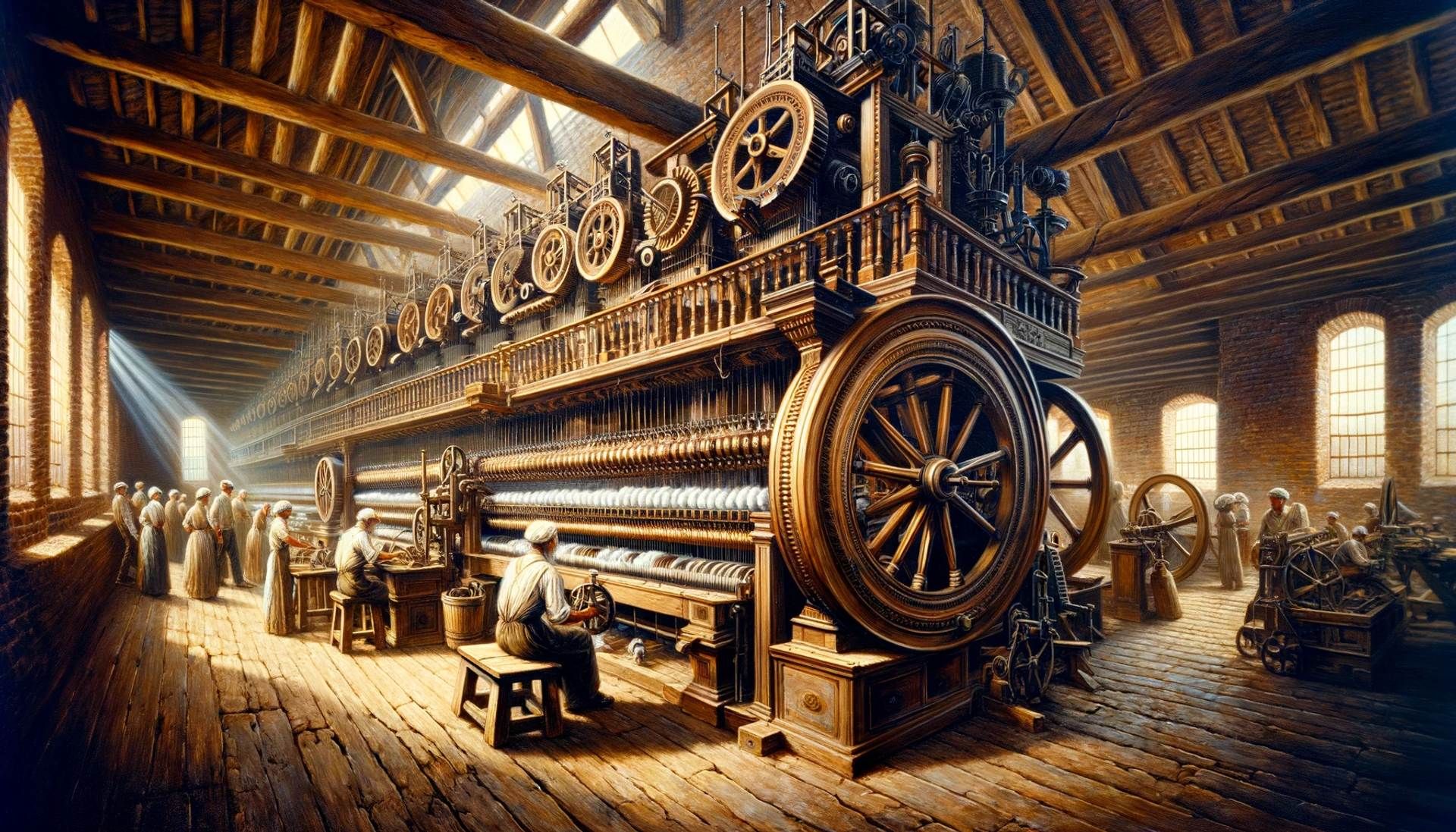
A cotton-spinning machine from the 19th century, that enabled huge productivity increases in the textile industry. © CS Media.
The Industrial Revolutions were a series of processes that began in the 19th century and transformed hand production into machine production. According to historian Eric Hobsbawm, they took the shackles off “the productive power of human societies” because, from then on, the global economy could achieve rapid and sustained growth. They are usually divided into two phases, or two separate events: the First Industrial Revolution and the Second Industrial Revolution. More recently, some authors have used the concepts of Third and Fourth Industrial Revolutions for digital advances and increasingly automated economic activity. Industrialization began in Britain and soon spread to Europe, North America and other regions. It has been a defining feature of humanity ever since.
Summary
- The Industrial Revolution was caused by population growth (which increased both the workforce and the consumer market), the expansion of capitalism, and the accumulation of capital enabled by colonialism.
- Great Britain was the pioneer of the Industrial Revolution, because it had several comparative advantages — such as colonies, capital, qualified workers, and a burgeoning mass market.
- The First Industrial Revolution began in the textile sector, with advancements that increased the productivity of cotton clothes production. It then spread to metallurgy (iron), transportation (railways and steam boats), and communications (telegraph). Some dissatisfied workers revolted against the mechanization of labor, to little avail.
- The Second Industrial Revolution was characterized by the usage of steel, electricity, petroleum, automobiles, airplanes, and the wireless telegraph. For the first time, machines were built to control other machines. In addition, new forms of capitalist organization emerged, and new countries began their path toward advanced industrialization.
- The Industrial Revolutions contributed to decrease the rural population and increase the urban population, which were subjected to equally bad living conditions. Although inequality worsened, workers were able to benefit from their concentration in urban centers to unionize and try to improve their situation. Finally, the spread of industrialization to other countries increased international competition, decreasing prices and workers’ salaries.
Causes of the Industrial Revolution and the Pioneering Role of Britain
In the 19th century, population growth, capitalism and colonial capital helped open an era of accelerating industrialization. The main factors were:
- Population growth: Thanks to medical breakthroughs, such as the spread of vaccines and antiseptics, and to agricultural improvements, such as the usage of the seed drill and better plowing methods, Europe’s population grew. This meant a larger workforce and an increased demand for goods.
- The expansion of capitalism: The growth of capitalist economies, in which individuals owned the means of production and competed for profit, drove the creation of new businesses. In addition, free trade policies encouraged the development of new productive activities in various countries.
- Colonialism: By profiting from colonial ventures, Europeans had money to spare, and a class of capitalists searched for opportunities to invest it. They became major drivers of industrial growth.
Back in the eighteenth century, there was a brief industrial expansion in certain corners of the globe. However, according to Eric Hobsbawm, for an Industrial Revolution to happen, two things were required: “first, an industry which already offered exceptional rewards for the manufacturer who could expand his output quickly, if need be, by reasonably cheap and simple innovations, and second, a world market largely monopolized by a single producing nation ”.
Great Britain pioneered the Industrial Revolution because it combined a profitable textile sector with command of the world market. These were the factors that helped the British achieve industrial dominance before any other society:
- Since the English Revolutions in the 17th century, particularly the Glorious Revolution (1688-1689), the British political establishment adopted the idea that the state had to defend individual rights and private property.
- The British Empire had the most colonies and became a hegemonic power after defeating France in the Seven Years’ War (1756-1763). This empire was strong enough to control global markets.
- The British had accumulated capital over the previous centuries through the Navigation Acts, which mostly restricted the transport of British products to British ships, and through unequal treaties. Under the Treaty of Methuen, for instance, the Portuguese exchanged wine for British textiles, generating significant trade surpluses for Britain.
- British nobility was gradually turning into a wealth-based aristocracy, rather than a mere hereditary aristocracy. The noblemen’s profits were usually reinvested in productive ventures, such as infrastructure projects.
- The agrarian economy that characterized Britain until the mid-eighteenth century had been progressively eliminated. The Enclosure Acts (1760-1830) turned commonly held lands into large fenced tracts that were privately owned and commercially exploited. From then on, rural workers lost access to land and had an incentive to find work in urban factories.
- French Huguenots made important contributions to British industry, for example, in the luxury sector. They were French citizens who had enjoyed religious freedom until the revocation of the Edict of Nantes by King Louis XIV, in 1685. Given the ensuing religious persecution of Protestant minorities, these men and women had emigrated to Britain.
- British society was relatively egalitarian, which permitted the formation of a mass market for industrial goods rather than a small luxury market serving the country’s elites.
- Britain had humid weather and abundant natural resources, which facilitated the cultivation and extraction of production inputs.
First Industrial Revolution: Inventions & Impacts
The first industry transformed in the 19th century was the textile industry, especially cotton production. Historically, this sector had its roots in British overseas triangular trade, which worked in the following way:
- Britain imported raw cotton from the Indies, through the East India Company — a state-owned firm that gained control of several territories and even had its own armed forces to defend its interests.
- Then, Britain turned this raw cotton into textiles, and exported them to its colonies in Asia and North America.
- Finally, Britain poured the profits of this trade into buying slaves for the colonies themselves, where they would work in the cultivation of cotton.
Because the cotton business was based on foreign trade, its potential was vast: the market for clothing was universal and the profits from slave labor were high. This status quo fostered the mechanization of textile production and trade, sectors that would eventually dominate the British economy. Even cotton growing in Britain was encouraged to offset disruptions in international trade.
Technical innovations such as the spinning machine, the water frame, the power loom and the cotton gin revolutionized clothing production. These machines significantly boosted cotton yield while addressing a critical challenge in the textile sector: the shortage of weavers. The demand for cotton products was soaring, but the number of skilled weavers could not keep pace. Because these machines were enormous, they could not be installed inside a worker’s home. As a result, a mechanized “factory system” emerged, with workers gathered in one place around equipment that managers could supervise.
In the 1830s and 1840s, the cotton sector began to face problems as both growth rates and profit rates declined. This was partly due to capitalism’s tendency to move through waves of expansion and contraction, and partly to more intense international competition in the clothing business. As a result, some proletarians and part of the petty bourgeoisie became dissatisfied with their economic position and reacted in several ways:
- The formation of mass movements in favor of democratic or republican ideals, like the Jacksonian Democracy in the United States.
- Chartism: The act of signing petitions to national parliaments demanding political reforms to the benefit of urban workers, such as the institution of universal suffrage, secret ballots and proportional representation.
- Luddism: The act of destroying certain kinds of cost-saving machinery that replaced skilled labor, thus increasing unemployment rates.
Both in Europe and in North America, governments and companies were unwilling to acquiesce to the wishes of workers and small producers and merchants. Certain repressive measures ensued, such as the Frame Breaking Act of 1812, in Britain, which established harsher penalties for breaking machinery.
The First Industrial Revolution continued and spread from textiles into energy, metallurgy, transport, communications and agriculture:
- With the invention of the steam engine, animal traction was superseded as a means of generating energy. At first, this device was used to pump water from British coal mines. Then, James Watt perfected it, so that it could have multiple uses. For instance, in the cotton industry, the steam engine enabled continuous production by providing a dependable source of power, unaffected by adverse weather conditions. This meant that mills could operate consistently, ensuring steady production levels.
- The construction of steam engines catalyzed advancements in metallurgy, as heavy machinery necessitated stronger materials. For instance, iron production became more efficient, leading to enhancements in its strength and durability.
- The advancements in metallurgy facilitated improvements in logistics and transportation. Railways and steam boats were the quintessential means of transport during the First Industrial Revolution. They put to good use the highlights of the period at the same time: steam engines, iron and coal. According to Eric Hobsbawm, the massive investment in railways was a consequence of Britain’s accumulation of capital and of the shortage of better investment opportunities — after all, in his words, most railways “yielded quite modest profits and many none at all”.
- In terms of communication technologies, the telegraph was invented from three different systems — from the Germans, the Americans and the British.
- In terms of agriculture, European countries began to cultivate sugar beet and to employ chemicals in their plantations.
Second Industrial Revolution: Inventions & Impacts
From 1860 onward, a new phase began: the Second Industrial Revolution differed from the First through new materials, fuels and systems of communication. Its main developments were:
- Iron was replaced by steel: Thanks to innovations in metallurgy, steel emerged as an alloy of iron and carbon with improved strength and resistance. Its use as a basic metallic material soon proliferated.
- Mechanical energy was replaced by electrical energy and petroleum: With the invention of the dynamo, it became possible to convert mechanical traction into electricity. Meanwhile, the invention of the internal combustion engine turned oil and natural gas into major sources of energy.
- Railways were replaced by cars, buses, trucks (and airplanes): With the widespread adoption of oil, common people were able to ride in oil-fueled vehicles such as the Ford Model T, idealized by Henry Ford in 1908. Also, military and commercial aviation emerged as a fledgling industry.
- The telegraph was replaced by the wireless telegraph: The transmission of text messages by radio waves paved the way for the invention of the radio, the wireless phone, and the television.

The Ford Model T, one of the most iconic cars of history, in an advertisement in “Life” magazine, in 1908. Public domain image.

One hallmark of the Second Industrial Revolution was the construction of machines that controlled other machines. This automated factories and enabled the consolidation of mass production, including highly efficient automobile assembly plants in the United States.
Meanwhile, new forms of capitalist organization appeared. Industries were henceforth tied to the banking sector, with banks and insurance companies playing a major role in industrial growth. Also, industries began to be owned not necessarily by their managers, but by stockholders. Those investors used trusts and cartels to coordinate production; mergers and holding companies extended the same logic by concentrating ownership. The goal was to lower costs, strengthen market power and keep regulation at a distance.
Due to the Second Industrial Revolution, several countries began to experience the benefits of industrialization more intensely. Factory production rose in newly unified Germany and Italy, as well as in Eastern Europe and Japan. Russia under Minister Sergei Witte was one example: he personally led efforts to improve the country’s infrastructure and had considerable success.
Social Consequences of the Industrial Revolutions
The development of industry brought major social and economic changes, especially in Western Europe.
As the population of Europe grew, so did its food consumption. Yet this happened in tandem with a decrease in the rural population, due to both social and technological reasons. The Enclosure Acts in Britain liquidated medieval cultivation practices, subsistence agriculture and “old-fashioned uncommercial attitudes towards the land” (as said by Eric Hobsbawm). There were attempts to frustrate the introduction of a capitalist mindset to agriculture, such as the Speenhamland system (measures to provide relief for the rural poor) and the Corn Laws (agricultural protectionism), but they all failed.
Facing a hostile environment in the countryside, rural populations migrated to cities and joined the industrial labor force. They grew accustomed to the rhythm of factory work through strict regulations and severe living conditions. For example, women and children were often employed in exhausting jobs because they were paid less than men.
In addition, the Industrial Revolutions led to worsened social inequality. While it is true that the welfare of the proletariat increased substantially, the life of urban workers was far from the comforts enjoyed by the bourgeoisie. Unequal incomes prevailed and many worked as hard as they did before industrialization, otherwise they were not able to earn a living. However, a welcome development was the fact that laborers could benefit from their concentration in urban areas to unionize and fight for improvements to their fate.
Finally, it should be noted that the spread of industries across many countries did increase international competition. Lower prices for consumer goods were beneficial to the masses, but they sometimes stood in the way of providing adequate financial support. The gains were uneven: Britain and other industrial exporters captured the strongest position in trade, while countries with less-developed industrial sectors were pushed into dependence on weaker terms.
Conclusion
The Industrial Revolutions have profoundly transformed the world since the 19th century. Initially, the textile industry epitomized this wave of innovation, as inventions like the spinning machine drastically enhanced productivity. However, these technological advances quickly permeated other sectors, unsettling skilled workers who found themselves increasingly marginalized in the workforce. The First Industrial Revolution carried steam power into industry and made railways, steamships and telegraphy central to production over distance. The Second reorganized that world around steel, electricity, petroleum-based transport and wireless communication. Because each technical shift changed where people worked and how firms competed, the social effects were just as large: urban migration accelerated, inequality sharpened, labor unions formed and international rivalry intensified. More recently, discussions in the 20th and 21st centuries have highlighted a Third and Fourth Industrial Revolution, continuing the legacy of profound change and innovation that characterizes this ongoing historical phenomenon.