
Napoleon alongside French soldiers in a battle. © CS Media.
The Napoleonic Era (1799-1815) ran from Napoleon Bonaparte’s rise after the French Revolution to his final defeat at Waterloo. Napoleon first ruled France as First Consul and then as Emperor of the French. During those years, his governments preserved some revolutionary reforms and imposed the Napoleonic Code. They also reorganized administration and fought wars that redrew much of Europe. The period linked the Revolution to the nineteenth-century order created after 1815: stronger states, redrawn borders, British maritime dominance, and independence movements in parts of the Americas.
Napoleonic Era Summary
- Napoleon was a rising star of the French Army and he colluded with politicians and intellectuals to topple the government of the last phase of the French Revolution — the National Directory.
- Initially, Napoleon became one of the three Consuls of France, in a power-sharing arrangement that was restricted to 10 years, but did little to curb his authoritarian tendencies. In 1802, approximately 99% of voters allowed Napoleon to become “First Consul for Life”, following a referendum.
- During the Consulate (1799-1804), Napoleon’s main goals were to make peace with foreign adversaries, reorganize domestic politics, and modernize the economy. All of those goals were met.
- In 1804, France held a second referendum, in which the population allowed Napoleon to change his status to Emperor of the French.
- During the First French Empire, Napoleon attempted to conquer hegemony in Europe, by invading and subjugating neighboring countries. However, the inability to defeat England and the difficulties to invade Russia ultimately made Napoleon an easy prey for foreign powers.
- In 1815, Napoleon was defeated and sent to exile on Elba Island. Yet he managed to escape from there, get back to France, and briefly lead the country before being defeated once more, at the Battle of Waterloo.
- Finally, Napoleon was sent to exile on Saint Helena Island, where he would die a few years later. Meanwhile, foreign powers restored the Bourbon monarchy in France, under the control of King Louis XVIII.
- Some consequences of the Napoleonic Era were changes to Europe’s political map, the independence of American countries, the rise of Great Britain as the main European power, and the development of certain economic sectors associated with life during the Napoleonic Wars.
The Consulate (1799-1804)
In 1799, Napoleon Bonaparte took power through the Consulate, a regime in which three consuls formally shared executive authority. He was the First Consul and his term was supposed to last 10 years. In practice, he held the greatest authority, and the functioning of the entire political system depended on him. From then on, a series of French constitutions reinforced Napoleon’s power. A positive development, however, was the return of universal male suffrage, since voting rights had been restricted to the propertied class during the last phase of the French Revolution.
Initially, the government’s main concern was the prolonged war with the monarchies of Europe. Since the early days of the Revolution, France’s neighbors had understood that the overthrow of King Louis XVI could encourage other European populations to do away with their monarchs, too. That is why they mounted successive coalitions against the revolutionaries. Even though the French Army won major victories in these wars, constant conflict threatened national stability. After rising to power, Napoleon tried to stabilize France by making peace with the rest of the continent.
The war against Austria ended with the Peace of Lunéville (1801). This treaty favored the French, who gained territory and continued to influence revolutionary governments in the Netherlands and Switzerland. Meanwhile, the war against England ended with the Peace of Amiens (1802). It was a more balanced treaty, because France and England each relinquished control of certain territories acquired during the war. In addition to ending these conflicts, Napoleon concluded the Concordat of 1801 with the pope. The agreement reconciled France with the Catholic Church, yet allowed the state to keep much of its power in religious matters.
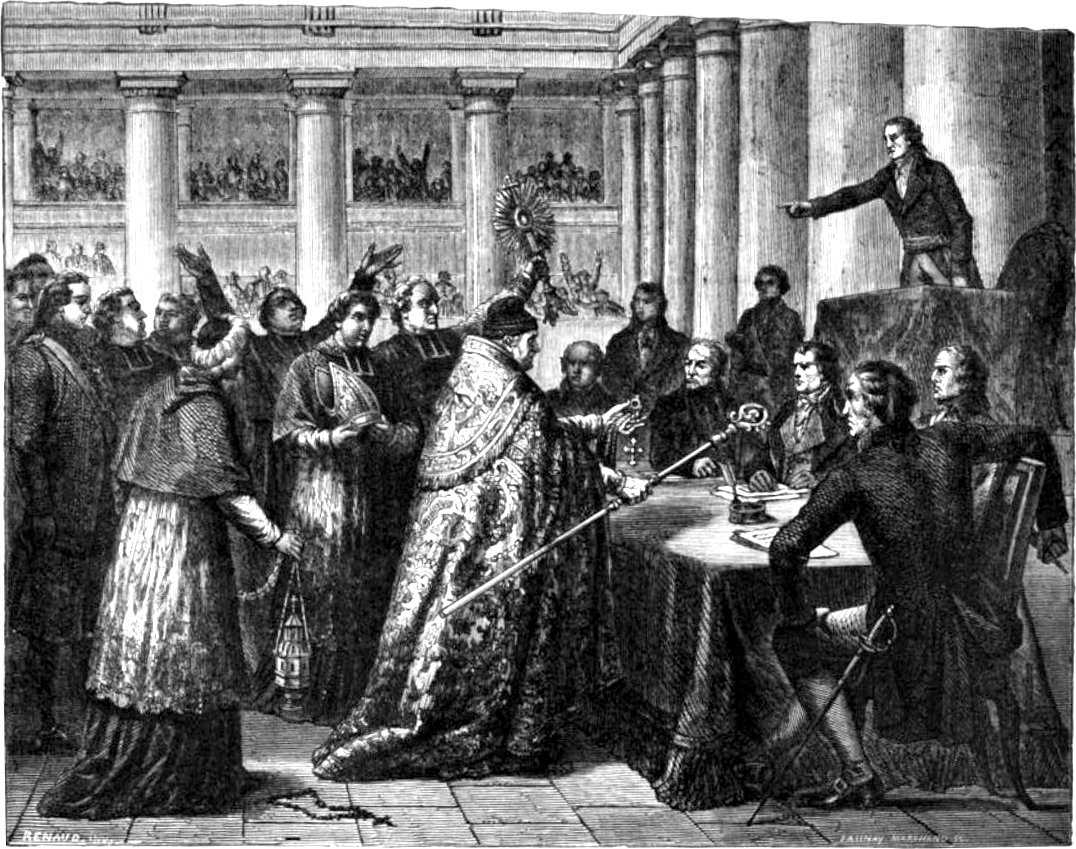
French clergymen taking an oath to the civil government, as required by the Concordat of 1801. Public domain image by unknown author.

Domestically, the Consulate government was quite productive. It implemented a series of measures intended to modernize the country, such as:
- Promulgation of the Napoleonic Code (Civil Code of the French): According to this piece of legislation, workers’ strikes were an assault on the economy, so they were forbidden. Women’s rights, including the right to vote, remained subject to the authority of fathers and husbands.
- Measures to ensure capital accumulation: Because the state needed money urgently, it reorganized the tax system, sold Louisiana to the United States, and created state institutions that fostered economic progress. Also, it encouraged the economic exploitation of land, both within France, by enacting a land reform, and outside France, by looting occupied countries.
- Measures to improve administrative efficiency: The French government became more centralized, for instance, by dividing the country’s territory into a series of departments with roughly the same area. The educational and judicial systems were also reformed.
- Measures to improve French infrastructure: Napoleon ordered the draining of swamps and the construction of roads, bridges and new government buildings — including memorials that honored himself.
Although those who opposed Napoleon were repressed by the government and there was no freedom of the press, life under the Consulate was stable enough to sustain his popularity. This allowed him to call a referendum in 1802. The vote turned him from “First Consul” into “First Consul for Life”, with approximately 99% of voters in favor of the change. Napoleon then organized another referendum in 1804. This time, approximately 99% of voters allowed him to become “Emperor of the French”. That vote ended the Consulate and opened the First French Empire.
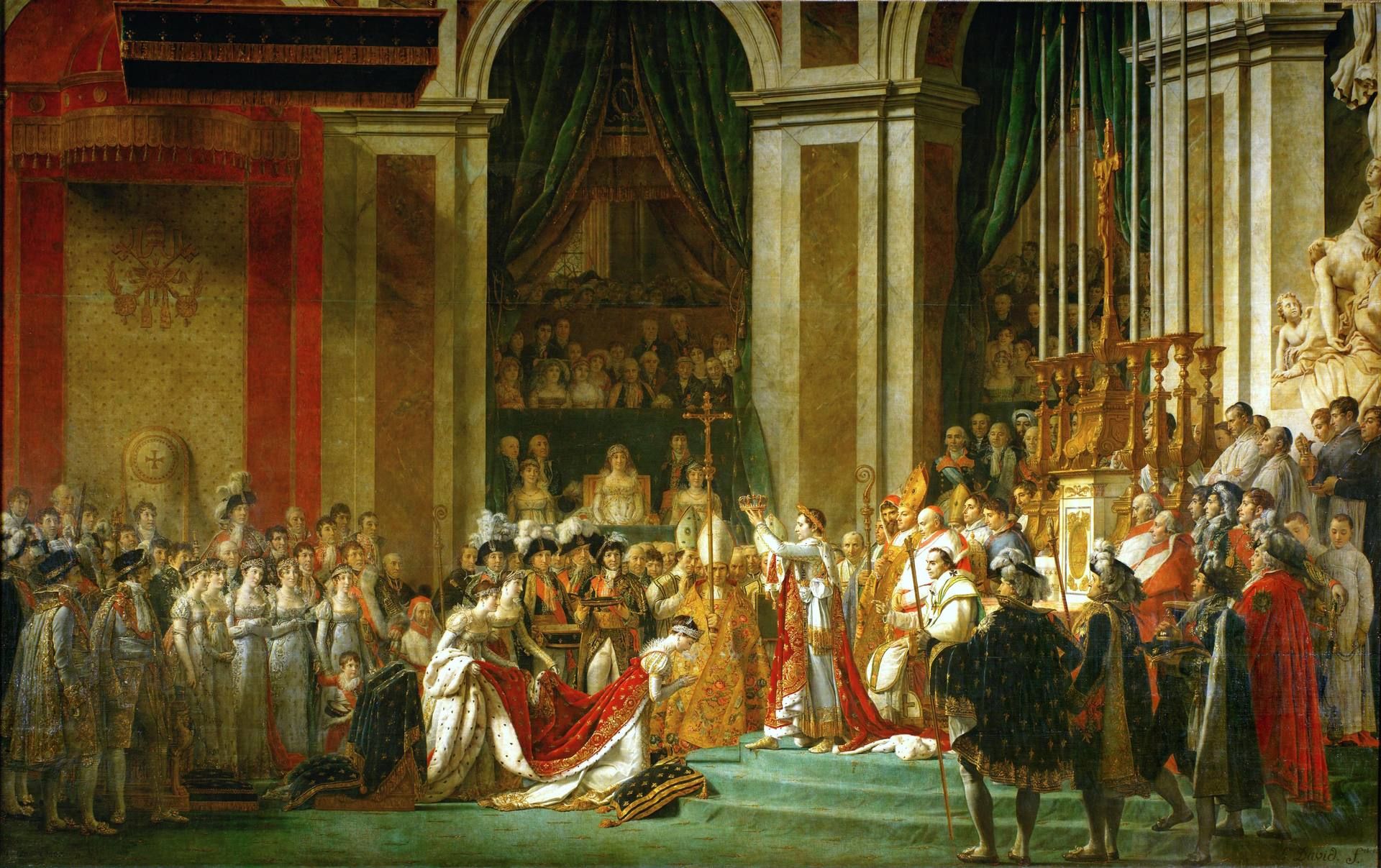
The coronation of Napoleon as Emperor of the French, represented by Jacques-Louis David and Georges Rouget. The work is in the public domain.

The Empire (1804-1815)
Napoleon’s monarchy seemed contradictory because the French Revolution had tried to overthrow monarchy. Many revolutionary institutions still persisted under the Napoleonic Empire. France continued to be ruled by a constitution. The principles of liberty, equality and fraternity were still generally respected. The main conflicts of this period became international. Napoleon sought hegemony in Europe while neighboring countries continued to fight the French.
According to the historian Eric Hobsbawm, the central rivalry of the period was the struggle between France and Britain. The British treated it as an economic and strategic contest: they advocated a balance of power in continental Europe while preserving their hegemony at sea and in the colonies. The French treated the rivalry as a broader struggle for victory over Britain itself. In any case, both powers pursued total victory.
In 1805 Napoleon attempted to invade Britain by sea, but the French Navy suffered a crushing defeat at the Battle of Trafalgar. That defeat pushed Napoleon toward continental domination, where French land power was strongest. His soldiers then defeated Austria, Prussia and Russia one after the other. They imposed unequal treaties on them and reorganized their territories. In 1807, France signed the Treaties of Tilsit with Prussia and Russia. Prussia became a vassal state, while Russia was forced to become a French ally. The humiliation imposed on these former powers was so great that Napoleon’s foreign minister Talleyrand resigned in protest.
Napoleon’s inability to invade Britain led him to issue the Berlin Decree and the Milan Decree. These orders created the Continental Blockade, a system that prohibited European countries from trading with the British. The goal was to strangle the British economy while favoring the French merchant navy and bourgeoisie. Several factors made the attempted blockade unsuccessful:
- European countries needed industrial goods from Britain, which was the major industrial power then, and the French could not supply them.
- European countries needed to sell their agricultural goods, but France produced those very same goods, thus would not import them. Only Britain could absorb the market for foodstuffs properly.
- In retaliation for the Continental System, Britain threatened to seize all vessels engaged in trade with the French, and launched violent attacks against those that aligned themselves with France.
Over time, Europeans disregarded Napoleon’s orders, and he retaliated. In 1807, Spain and France signed the Treaty of Fontainebleau, according to which both would invade Portugal, a traditional British ally that seemed reluctant to abide by the Continental Blockade. The French Army reached Portugal through Spanish territory, and the passage of troops traumatized Spain. The Spanish population revolted against King Charles IV for getting involved in Napoleon’s plans, and he abdicated in favor of his son, Ferdinand VII. Napoleon placed both father and son under house arrest, and his brother Joseph Bonaparte became King of Spain. The Portuguese royal family escaped that fate because Britain helped the House of Braganza flee to Brazil.
Why Napoleon Fell (1812-1815)
In 1807 the Treaty of Tilsit forced Russia to become a French ally, and as a result the country adopted the blockade against England. However, in 1809, France annexed the Austrian territory of Western Galicia to one of its client states. This was against Russian interests, because the region could be used as a potential launching point for an attack against them. On 31 December 1810, Tsar Alexander decided to abandon the Continental System.
Suddenly, Napoleon lost a key ally in the struggle against British dominance at sea. The crisis deepened because Alexander wanted to pursue expansionist policies and would not let France keep its military presence in Prussia and Western Galicia. In 1812, Russia issued an ultimatum demanding the withdrawal of French troops from these regions. Napoleon treated this as an affront, declared war against Russia, and began moving troops across its borders. At first, the French Army advanced while the Russians retreated. The Russians then employed scorched-earth tactics, leaving behind abandoned cities, burned fields, and broken infrastructure. Russia trapped the French in a grim theater of war during the harsh Russian winter.
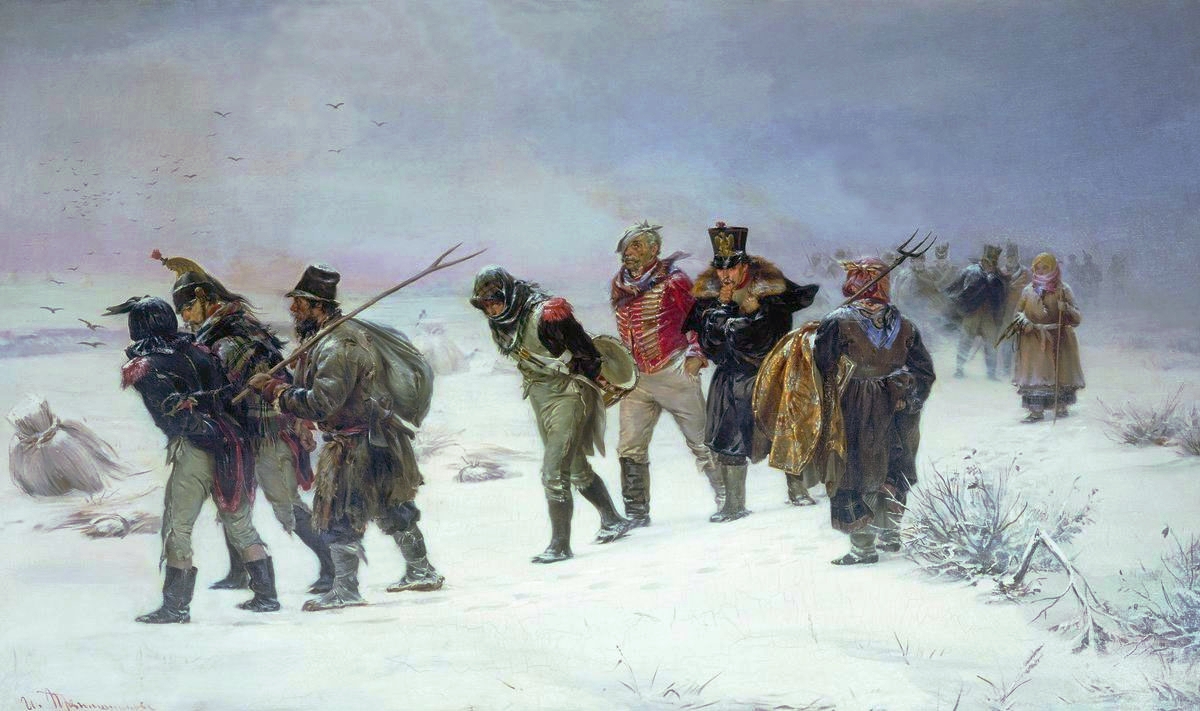
“French retreat from Russia”, a painting by Illarion Pryanishnikov. This painting is in the public domain.

Unable to dominate Russia, Napoleon’s men were forced to retreat, giving their adversaries time to react. In 1813, a coalition of Austria, Prussia, Sweden and Russia overpowered the French at the Battle of Leipzig. In the following year, foreign powers invaded Paris and forced Napoleon to abdicate. While these powers met at the Congress of Vienna (1814-1815), Napoleon was exiled to Elba Island. Europe’s leaders decided that the dynasties deposed by Napoleon would regain their thrones. Thus, the brother of the guillotined king Louis XVI, Louis XVIII, began to rule France.
Nevertheless, Napoleon used his private guards to escape from Elba Island, near the Italian coast. In 1815, while Europe’s monarchs and their representatives convened in Vienna, Napoleon returned to France. He reunited his army and mounted another challenge to European order. This period became known as the Hundred Days, because Napoleon remained in power for 110 days. The counterrevolutionary coalition soon came to the rescue of Louis XVIII. At the Battle of Waterloo, Napoleon’s troops were defeated one final time, and he was exiled to Saint Helena, where he died in 1821.
Main Consequences of the Napoleonic Era
The Napoleonic Era preserved many aspects of the French Revolution while turning France into an empire ruled by Napoleon. Napoleon went from being a general of an anti-monarchical movement to being the ruler of a much-changed France. The Napoleonic Wars brought political, economic, and social changes that mostly persisted even after the Bourbon dynasty returned to power. These were some of the main consequences of this period:
- The European map was reorganized: Because Feudalism was completely dismantled, the modern European state prevailed as the only acceptable type of national-political entity in Europe at the time.
- Great Britain acquired many colonies: Because several European powers faced constant war, continental issues took their full attention and the British seized the opportunity to increase its overseas empire.
- Some colonies got their independence: Napoleon weakened the colonial powers of Europe, like Spain and Portugal, facilitating the independence of Spanish America and Brazil. Also, even France itself lost Haiti, because slaves revolted against the reimposition of slavery during the French Revolution.
- Napoleonic creations persisted all over the world: When in power, Napoleon implemented measures such as the Civil Code, both in France and in French sister republics. These new laws and institutions were widely considered better than the previous ones, and they lived on indefinitely.
- Most Europeans did not participate in the Napoleonic Wars: While it is true that the French inaugurated mass conscription and adopted an ethos of “total war”, the number of soldiers was a tiny part of Europe’s population.
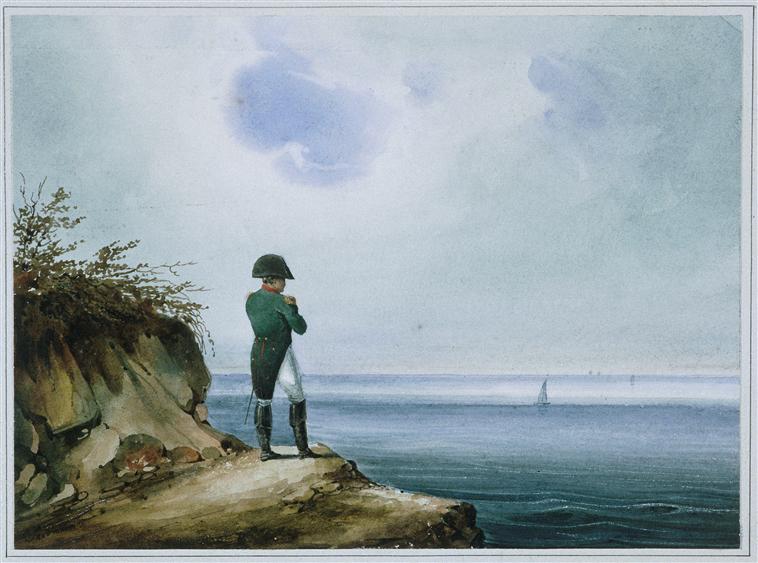
“Napoleon in Saint Helena”, a painting by Franz Josef Sandman. Its source file identifies it as public domain.

- The Napoleonic Wars were not as deadly as other conflicts: Many people died during this period, but many more had died in previous wars or would die in subsequent wars. Also, as a whole, more people died from poor health conditions than from actual combat injuries in the Napoleonic Era.
- The Napoleonic Wars familiarized the world with paper currency and inflation: Money was needed to finance the conflict, so the European powers printed vast quantities of it. Sometimes, they increased taxes, too, but this alternative was mostly avoided because it could garner popular opposition.
- The Napoleonic Wars disrupted the economy, but they also encouraged certain economic sectors: Coal and steel were desperately needed in order to produce weapons and transport troops over land. In addition, beet sugar was on the rise as an alternative to sugarcane sugar from distant colonies. The British also popularized canned food to be used by their Navy.
- The Napoleonic Wars had different effects for the French and for the British: France was briefly demoted to second-rank power in Europe, while Britain was able to destroy its main rival.
Historical Significance of the Napoleonic Era
The Napoleonic Era reshaped European politics well beyond France’s borders. Napoleon rose as the French Army gained influence during the collapse of the Directory, then used the Consulate to stabilize government and rebuild France’s economy through administrative reform. After 1804, his rule became more openly imperial and violent. The Napoleonic Wars shook the continent and provoked a sustained response from the enemies of the Revolution. In 1815, those foreign powers prevailed, and Napoleon lived his final years in isolation on Saint Helena. The consequences of his search for supremacy in Europe persisted after his death in 1821. They appeared especially in state administration, legal reform, warfare, diplomacy and the political map created after the Congress of Vienna.