
“The People at Tuileries”, a lithography by Victor Adam showing the throne room of the Tuileries Palace being seized by a crowd in 1848. Public domain image.
The Revolutions of 1848 were a chain of uprisings that spread across Europe in 1848 with demands for constitutional government and civil rights as well as national self-determination and relief from economic crisis. Because so many peoples revolted almost simultaneously, the movement became known as the Springtime of the Peoples. The revolutions turned liberal, national, and social grievances into a continent-wide challenge to the post-Napoleonic order.
The 1848 revolutions belonged to the broader 19th-century challenge to the autocratic order of the Concert of Europe. Even after the French Revolution and the Napoleonic Era had been defeated, liberal and nationalist ideas remained influential across Europe. The revolutions of the 1820s and 1830s had already shown that the post-Napoleonic settlement was unstable. By 1848, crop failures and urban unemployment gave those older political demands a sharper social urgency across several capitals and provincial towns.
Although the uprisings differed by region, class, and national program, they shared a few broad characteristics:
- Leadership often began among middle-class liberals, professionals, students, and intellectuals, while workers and poorer urban groups entered the movements as crises deepened.
- They challenged absolutism, restricted monarchies, and censorship by demanding constitutions, civil rights, representative institutions, or national self-government.
- They drew on transnational liberal and nationalist networks, including exile circles, but local economic distress and political repression triggered the uprisings in different ways.
The main revolutions in the context of the Springtime of the Peoples were:
- February Revolution in France
- Frankfurt Parliament in the German Confederation
- The uprisings in the Habsburg Monarchy
- Sonderbund War in Switzerland
- Constitutional Reform in the Netherlands
February Revolution in France
In the years preceding 1848, discontent with the rule of King Louis Philippe motivated private political meetings known as the “banquet campaign”. The moderate left-wing opposition organized these encounters, where the people criticized the economic crisis in the country and proposed a reform of the electoral law, so as to increase enfranchisement. However, the king and the government were vehemently opposed to these meetings, so the French cabinet began to prohibit them — much like it already prohibited public gatherings.
In February 1848, the Paris population rebelled against these prohibitions. It quickly deposed Louis-Philippe and replaced him with a republican government: the French Second Republic. The February Revolution replaced the July Monarchy with the Second Republic. Conservative reaction soon limited the republic’s social program. The new leaders of the country implemented a constitution containing direct universal suffrage and the separation of powers. Nevertheless, a conservative backlash soon took place, essentially nullifying the progressive tendencies of the regime, such as by disenfranchising many factory workers. Because the French were divided into opposing factions, political turmoil ensued and the military had to resort to violence in order to stabilize the country.
In October, one of the French generals in charge of political repression, Louis-Eugène Cavaignac, ran for president against Louis-Napoleon Bonaparte. Louis-Napoleon was the nephew of the late Napoleon Bonaparte. The Bonapartist faction won with almost 75% of the votes, and Louis-Napoleon soon found himself at odds with France’s political elites. He aspired to restore universal male suffrage and to abolish the constitution’s ban on presidential reelection. Unable to do so democratically, he staged a self-coup in 1851, later approved by a referendum, and stayed in power. The following year, he proclaimed himself Napoleon III and replaced the Republic with the Second French Empire.
Frankfurt Parliament in the German Confederation
All over the territory of the German Confederation, there were a series of loosely coordinated protests and rebellions. They were based on pan-Germanism, the notion that the Confederation should be transformed into a single country, rather than continuing to be a multiplicity of small states led by Austria and Prussia. In most cases, these revolts had little impact because the governments quickly defeated them. However, an exception was the so-called Frankfurt Parliament.
In 1848, liberals from various parts of Germany called for free elections for a national parliament — the first of its kind in the region’s history. Each member of the Confederation held its own voting procedures, and the Frankfurt National Assembly convened in May. Even though all political tendencies had a seat there, most delegates were moderate liberals: teachers, professors, or undergraduates. That composition motivated the moniker of “professors’ parliament”.
The Frankfurt Parliament made German unification a constitutional project, but it lacked the coercive power of Austria or Prussia. The parliamentarians appointed a Regent of Germany and engaged in discussions about the country’s territorial extent and political structures after unification.
The former issue concerned the inclusion of German-speaking regions of Austria in a future unified Germany. The Austrians adopted a new constitution that demanded that either the whole of the country be included in a future Germany, or none of it.
The latter issue concerned Germany’s future form of government. The parliament decided to offer the German crown, excluding Austria, to the king of Prussia. However, Frederick William IV refused this endeavor because it conflicted with his conservative worldviews.
Without the support of either Austria or Prussia, the Frankfurt Parliament would never succeed in unifying Germany, so the members of the German Confederation dismantled it.
Why did the Revolutions of 1848 fail?
The revolutions failed politically because their coalitions split faster than conservative armies and bureaucracies did. Most of the Revolutions of 1848 failed because the revolutionary coalitions included groups with incompatible priorities. Liberals wanted constitutions, parliaments, civil rights, and limits on royal authority. Workers and poorer urban groups often wanted stronger social reforms, especially after unemployment and food shortages had made daily life more difficult. Nationalists wanted independence or unification. In some regions, national movements also made incompatible territorial claims. As a result, the forces that had united against absolutism often split once old governments began to retreat.
Conservative rulers also recovered because they still controlled armies, bureaucracies, and diplomatic alliances. In several countries, monarchs made concessions during the first weeks of unrest. They waited for divisions among the revolutionaries to grow and then used loyal military forces to restore order. The revolutions therefore failed to create most of the national states or liberal regimes that their supporters imagined in 1848.
Some results endured despite counterrevolution. Reforms such as the abolition of serfdom in the Habsburg lands and the new federal constitution in Switzerland survived. The experience of 1848 also shaped later politics. It showed liberals and nationalists that unification in Italy and Germany would require stronger states, armies, and diplomatic strategy alongside popular assemblies and street uprisings.
After 1849, the restored conservative order was more cautious than before the uprisings. Governments retained the power to repress radicals. At the same time, censorship and restricted suffrage could combine with food crises and unresolved national questions to bring large groups into politics again. That tension explains why 1848 was both a revolutionary defeat and a warning to Europe’s old regimes.
The experience of 1848 showed that the old regimes could not simply return to the political habits of 1815. Even where constitutions were revoked, rulers had to govern populations that had seen mass politics, national programs, and social demands become public forces. In that sense, 1848 remained a reference point for later reformers and revolutionaries.
The uprisings in the Habsburg Monarchy
In the years preceding 1848, the Habsburg monarchy had to deal with several problems: a mounting economic crisis; tensions related to land ownership; and the spread of liberal, nationalist, and left-wing ideologies. For instance, a fungus that causes potato blight arrived in Austria and contributed to widespread hunger, because potatoes were a staple food of poor segments of society.
In the context of the Springtime of the Peoples, the Austrians received news of the February Revolution in France and rose in revolt as well. The Habsburg lands’ national divisions helped conservative rulers turn revolutionary momentum against itself. The rebels succeeded in sending the influential conservative statesman Metternich into exile. However, the multinational character of the Habsburg Monarchy made things difficult for the revolutionaries. The various national groups that lived there did not see eye to eye, and the conservatives took advantage of this fact to regain power. Over the months of 1848, liberals and conservatives succeeded one another in the government. For a brief time, even members of the Habsburg royal family fled the country.
By the end of 1848, the counterrevolutionary forces prevailed, having executed the leaders of the radicals and dismissed a proposal for a constitution in liberal terms. King Ferdinand I regained full powers, but was convinced to abdicate in favor of his nephew, Franz Joseph I. Although the new monarch rejected the constitutional monarchy that had been established and attempted to restore absolutism in Austria, he maintained a few achievements of the revolutionary government — notably, the abolition of serfdom and the end of censorship.
Meanwhile, in the Hungarian part of the Empire, the population rose against Austrian authoritarian rule. Under the leadership of Lajos Kossuth, the rebels instituted the March Laws to inaugurate a parliamentary democracy and guarantee many civil rights. For instance, the document supported the abolition of serfdom; the principle of equality before the law; and freedom of the press. However, Franz Joseph I arbitrarily revoked the laws, which became the catalyst for a revolution.
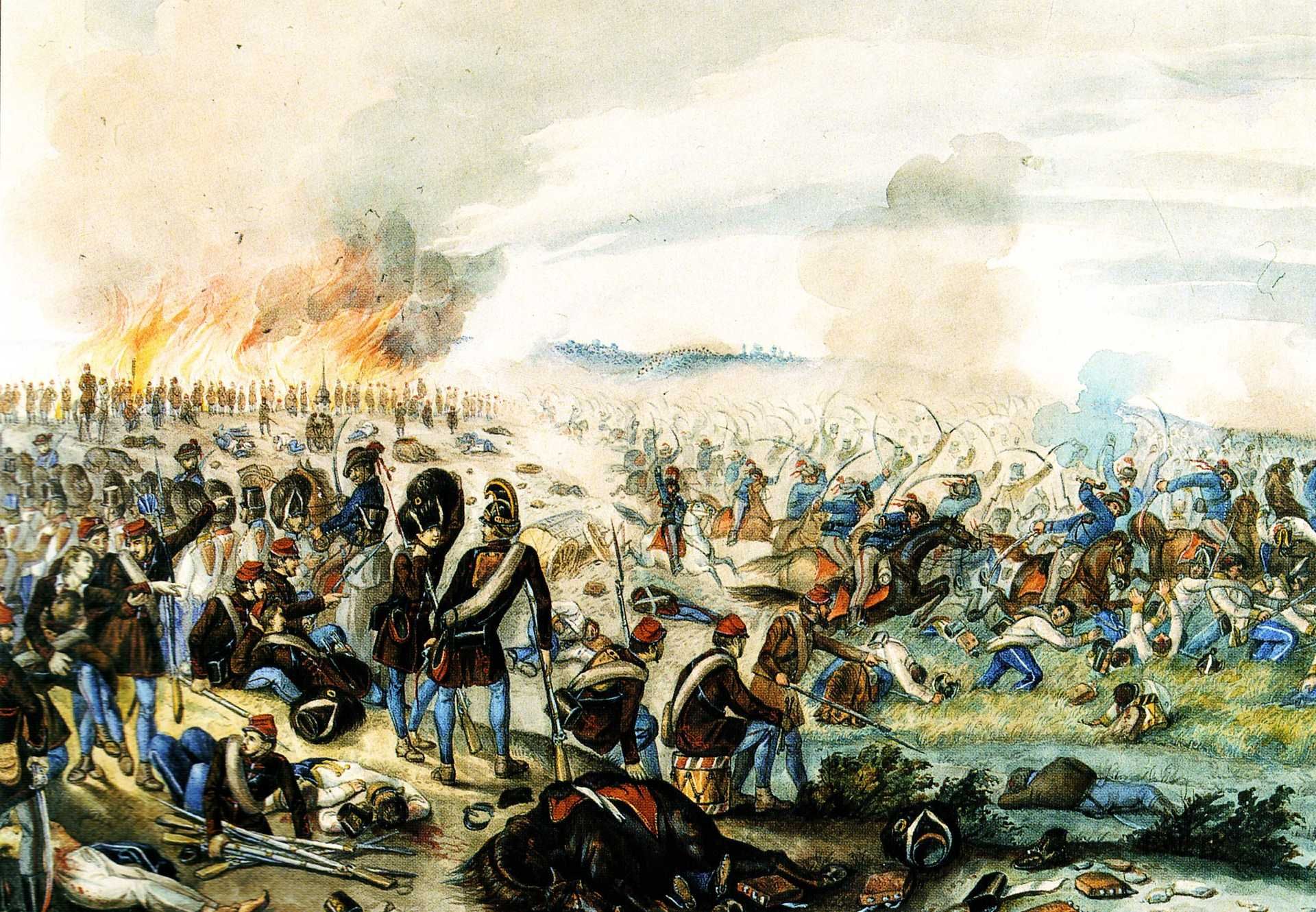
The Hungarian cavalry pursuing counterrevolutionaries in the battle of Nagysaló, April 19, 1849. Oil painting by Than Mór. Public domain image.
While the followers of Lajos Kossuth defended Hungarian independence, the local government of Lajos Batthyány proposed a reconciliation with the Habsburg dynasty. Batthyány was eventually ousted, and the Hungarians nearly achieved independence, but Austria managed to crush the revolution and impose a military dictatorship in Hungary with Russian assistance.
Sonderbund War in Switzerland
At the time, Switzerland was a confederacy divided into cantons (states) that were either mostly Catholic or mostly Protestant. In the early 1840s, Protestants achieved a majority in the Swiss parliament (the Federal Diet). They used it to propose a new constitution for the country. The Sonderbund conflict showed that 1848 also involved constitutional consolidation, not only failed revolution. Their goal was to centralize power, but Catholics objected because they believed it would run counter to their interests. Indeed, this is what happened soon after, when the Federal Diet adopted measures against the Catholic Church, such as closing monasteries.
In 1843, in an attempt to preserve their autonomy, the Catholic cantons formed the Sonderbund — a “separate alliance”. Yet the Federal Treaty of 1815 expressly prohibited such alliances, and the Protestant cantons enforced this rule by engaging in military action against their Catholic counterparts.
In 1847, a civil war ensued: the Sonderbund War. Even though both Austria and France wanted to intervene in support of the Catholics, Britain vetoed their intentions and no foreign intervention occurred. After a few weeks, the Protestant cantons defeated the secessionists and imposed the Swiss Constitution of 1848. This document provided that the country would become a federative state, with less autonomy for cantons, and that Jesuits would be expelled from its territory.
Constitutional Reform in the Netherlands
In 1848, news of revolutions in various European countries arrived in the Netherlands, where they prompted King William II to accede to the demands from the liberal parliamentary opposition. He set up a commission to devise a constitutional reform under liberal terms. Then, he negotiated with the majority of conservative politicians in order to secure support for the proposal. In the same year, the reform entered into force with the following highlights:
- The responsibility for governing passed from the king to the ministers.
- The common people would vote for provincial elections, and the provincial bodies would choose the members of the Senate.
- The powers of the parliament increased substantially.
- Several civil rights were adopted: freedom of assembly, freedom of association, freedom of education (parents could educate their children as they saw fit), religious freedom and the right to privacy of correspondence.
The main characteristic of the 1848 reform in the Netherlands was that, unlike in other European countries, the changes were carried out peacefully.
Historical Significance of the Revolutions of 1848
The Revolutions of 1848 were the last major wave of European revolutionary politics before the unification of Italy and the unification of Germany. They continued the pattern of the 1820s and 1830s, helping to weaken monarchical absolutism, widen the language of civil rights, and keep national unification on the European political agenda. Their defeat did not erase the problems they exposed: constitutions, citizenship, national unification, and social reform remained central European questions.