
French noblemen being taken away by revolutionaries. © CS Media.
The French Revolution (1789-1799) transformed France from an absolutist monarchy into a revolutionary republic before ending with Napoleon Bonaparte’s seizure of power. It was caused by political and fiscal crises as well as social and administrative crises that gave wider force to ideas from the Enlightenment. It began when the bourgeoisie challenged privileges granted to clergy and nobility, then moved into a wider struggle over representation and sovereignty as well as war and social reform. The Revolution instituted a constitutional monarchy and later abolished monarchy altogether. It confronted foreign coalitions and opened cracks in the modern European states. It ended in 1799 with Napoleon Bonaparte’s rise to power.
According to the historian Eric Hobsbawm in The Age of Revolution, the French Revolution became the most important revolution of its age because it joined mass politics, radical social claims, and a universal political language. It happened in Europe’s most powerful and populous country after Russia. It also involved the masses and was “immeasurably more radical than any comparable upheaval”. Finally, it was an ecumenical revolution, because its ideals reverberated across the world.
Summary of the French Revolution
- It was caused by political, social, economic, and administrative crises that destabilized the absolutist rule of Louis XVI.
- It began when the government wanted to tax clergymen and noblemen, both rejected it, and the common people wanted to institute a French Constitution, so as to limit the powers and privileges of the upper classes.
- After the storming of the Bastille, revolutionary politics divided into loose factions: Girondins (the Right), Jacobins (the Left), The Plain or The Marsh (the Center), and Sans-Culottes (the Far Left).
- The first phase was the National Assembly, dominated by the Girondins, which created a constitutional monarchy and abolished certain class privileges.
- The second phase was the National Convention, dominated by the Jacobins and the Sans-Culottes, which created a republic and introduced radical measures, including mass executions during the Reign of Terror.
- The third and last phase was the Directory, dominated by the Girondins, which kept the republic but abolished most radical measures of the preceding period. The Directory struggled at home but won several wars abroad, strengthening the public image of the army and especially of Napoleon Bonaparte.
- Finally, Napoleon used his popularity to stage a coup, ending the French Revolution and beginning the Napoleonic Era.
Causes of the Revolution
In the years before 1789, France’s political and social crises, together with fiscal and administrative pressures, reinforced one another and weakened Louis XVI’s monarchy.
- Political crisis: Ever since the reign of Louis XIV (1643-1715), the Sun King, France had adopted a repressive strand of European absolutism. The monarch ruled over almost everything, and opposition had little room to organize. The Sun King was succeeded by Louis XV (1715-1774) and Louis XVI (1774-1792). Louis XVI had little rapport with French society, a problem exemplified by the social rejection of Queen Marie Antoinette. The famous story that she replied “Let them eat cake” when told peasants had no bread has no evidence behind it, but its circulation shows how easily criticism of the royal family spread. Opposition to the monarchy helped radical ideas from the Enlightenment gain a wider audience.
- Social crisis: French society was brutally unequal. The First Estate and the Second Estate comprised a tiny minority, but they had land to spare and did not pay taxes. In the meantime, the Third Estate financed both the government and the other two estates. It was composed of peasants, urban workers, poor priests and the bourgeoisie, which had more economic power than the others, but remained devoid of political power. As the merchant class rose, it felt the need to abolish social privileges enshrined by the regime.
- Economic crisis: For a long time, many people blamed state finances on the expenses of the clergy and nobility. Those expenses were relatively limited, while pre-revolutionary France faced deeper fiscal and economic pressures. The kingdom had spent heavily on conflicts such as the Seven Years’ War and on support for United States independence. French manufacturing was also disrupted after the Eden Agreement opened new trade with Britain. Then a devastating hailstorm and severe winter hit France in 1788-1789, producing a poor harvest and food shortages among peasants. Many noble families also owed large debts to the bourgeoisie.
- Administrative crisis: The French state needed reform because expenditures outpaced revenue. Some ministers and counselors attempted to overhaul state affairs, but their efforts were thwarted. One example is Anne Robert Jacques Turgot, an economist who served as Controller-General of Finances. As an advocate of Physiocracy, he tried to cut sinecures and public pensions. His liberalizing policies had little support from the rest of the government or from the market. In 1776, he was pressured to resign.
According to the historian Michel Vovelle, the French Revolution can be read in two ways. One reading treats it as a “poverty revolution”, because peasants lived in precarious conditions and took radical action after food prices rose. The other treats it as a “prosperity revolution”, because the bourgeoisie took the initiative to protect its own rise. Some authors, such as Edward Burns, favor the latter view and emphasize that the poor joined the Revolution only after the bourgeoisie had set it in motion.
The Beginning: Estates General and Bastille
In 1787, the French state faced rising expenditures, and its debt made it unlikely that private creditors would cover the gap. Government revenue came from the Third Estate, but it was insufficient. Liberal minister Charles Alexandre de Calonne wanted to tax the clergy and nobility because their wealth and land remained largely shielded from ordinary taxation. He handpicked an Assembly of Notables to approve the new taxes, but his plan fell apart when noblemen rejected the idea.
At the request of the Assembly of Notables, Louis XVI summoned the Estates-General of 1789, a parliament that represented the estates of the realm and merely advised the monarch. This institution had rarely been summoned in French history, so its return showed how trapped royal politics had become. The Estates General convened in 1789, at first granting one vote to each of the three social estates. As a result, the clergy and nobility outvoted the common people two to one and dismissed the proposal to introduce taxes that would affect them.

“Opening session of the General Assembly, 5 May 1789”, by Auguste Couder, showing the inauguration of the Estates General. Public domain image.
The Third Estate first reacted by requesting a change in the voting rules, so that it could ally with dissident clergymen and noblemen. Louis XVI rejected this proposal and took retaliatory measures against the Estates General. The king emphasized the separation of the three estates, annulled the body’s decrees, and dictated what it should approve instead. When that was not enough to quell the opposition, he closed the Estates General.
By then, both ordinary people and the bourgeoisie intended to keep reorganizing French politics and the economy. They also intended to reorganize society. On 20 June 1789, representatives of the Third Estate reconvened in a nearby tennis court and vowed to negotiate a constitution limiting the king’s power. Of all 577 representatives, only one did not join the Tennis Court Oath: Joseph Martin-Dauch, who decided to follow the monarch’s orders.
Initially, Louis XVI felt the social pressure and accepted the plan to draft a constitution. Nevertheless, while the constituents debated, they feared that Louis XVI would order a military strike on the assembly. When it became public that troops loyal to the monarchy were being assembled, the Third Estate carried out the storming of the Bastille. The almost abandoned prison remained a symbol of royal power. The revolutionaries took up arms and began to fight the monarchy, starting the French Revolution.
Political Divisions within Revolutionary France
During the French Revolution, the Third Estate split into ideological groupings that shaped later ideas of right and left as well as moderation and popular radicalism. These groupings were not organized political parties. They were loose associations built around shared political positions. These were the most important groups:
- Girondins: They were members of the upper bourgeoisie, like independent professionals and members of the middle class. They usually sat at the rightmost seats whenever the Third Estate convened, and for that reason their ideas became known as the ideas of the Right. They defended moderate policies such as economic liberalism and keeping Louis XVI under a constitution.
- Jacobins: They were members of the lower bourgeoisie, like small merchants and urban workers at manufacturing plants. They usually took up the leftmost seats in Third Estate assemblies, and thus their ideas became known as the ideas of the Left. They endorsed more radical measures, such as replacing the Monarchy with a Republic and intervening in the economy. In order to advance their ideology, they frequently turned to political violence.
- The Plain or The Marsh: They were uncommitted politicians who did not adhere to a single ideology, were not part of any political club, and lacked leadership. Their designation comes from the fact that they usually sat at ground level in Third Estate assemblies. In terms of ideology, they were moderates who allied with either Girondins or Jacobins sporadically.
- Sans-Culottes: They came from the lowest social classes, representing the peasants and the urban poor. Because of this, they adopted far-left ideals, such as direct democracy (people participating in politics without any intermediaries) and heavy government intervention in the economy, in order to control prices. Generally, they allied only with Jacobins.
1st Phase: National Assembly (1789-1792)
After common people stormed the Bastille and took up arms, some politicians who did not have national prominence formed the Paris Commune. It was a municipal assembly controlled by the Jacobins, in which there was criticism of the national government. In the meantime, the French Revolution entered its first phase, the National Assembly, which got its name from the institution that was elaborating a constitution for the country as a whole.
This phase was characterized by the rise to power of the Girondins, who had to face a situation known as the Great Fear. Across the country, peasants feared that food shortages were part of an aristocratic plot to starve them. They armed themselves and began to attack the nobility, threatening the stability of French society. Meanwhile, Third Estate representatives in Paris feared the peasants would make their way to the capital. To avoid such disruption, the Girondins adopted moderate policies meant to reassure peasants about the value of the Revolution:
- Abolition of feudal rights: Even though Feudalism was long gone, certain privileges associated to it remained in France. Noblemen and clergymen had a monopoly over land, and the Third Estate was bound to pay taxes and duties to the nobility. All of it would end immediately.
- Confiscation of Church properties: Every single piece of land and money that the Catholic Church had was seized by the government. These assets would serve to back a new paper currency created by the revolutionaries, called an assignat, so as to avoid generalized bankruptcies. Unfortunately, the assignats failed to keep inflation in check and the economy collapsed.
- Promulgation of the Civil Constitution of the Clergy: The members of the clergy would be considered government employees, rather than Church employees. They were forced to forgo the rule of the Pope in favor of the principles set out by the National Assembly — including the fact that Church officials would be elected instead of chosen by Rome. Confronted with these changes, some priests accepted them, forming the Constitutional Clergy, while others entirely rejected them, forming the Refractory Clergy.
- Promulgation of the Declaration of the Rights of Man and of the Citizen: This was a human rights document that announced the main values of the French Revolution — Liberty, Equality and Fraternity (Liberté, Égalité, Fraternité). Based upon the ideals of the Enlightenment, it established that all men were equal before the law and all deserved to be free and to own private property. However, the Declaration did not envisage any ideas about the economic well-being of the masses.
- Promulgation of the Le Chapelier Law: In order to extinguish the last traces of Mercantilism from France, this piece of legislation prescribed free trade as the norm. Yet workers’ economic liberty was to be curtailed by a ban on the formation of guilds (early versions of trade unions) and by a ban on the right to strike. This law evidently went against the interests of the masses, but entered into force anyway, as a way to stabilize the country.
Subsequently, the National Assembly turned France into a constitutional monarchy after approving the Constitution of 1791. It enshrined the principle of the separation of powers, ensuring that the king would not rule in an absolutist fashion. It kept the separation of Church and state that had already appeared when nationalizing the clergy. As proof of the Girondin control over the constituents, voting rights were restricted to propertied men, excluding women and the poor. Because of this, only about 15% of the French population were able to vote. Finally, in order to secure popular support for the revolutionary government, the Constitution dictated that national festivities had to be performed, mostly in open spaces and outside the main Parisian Squares.
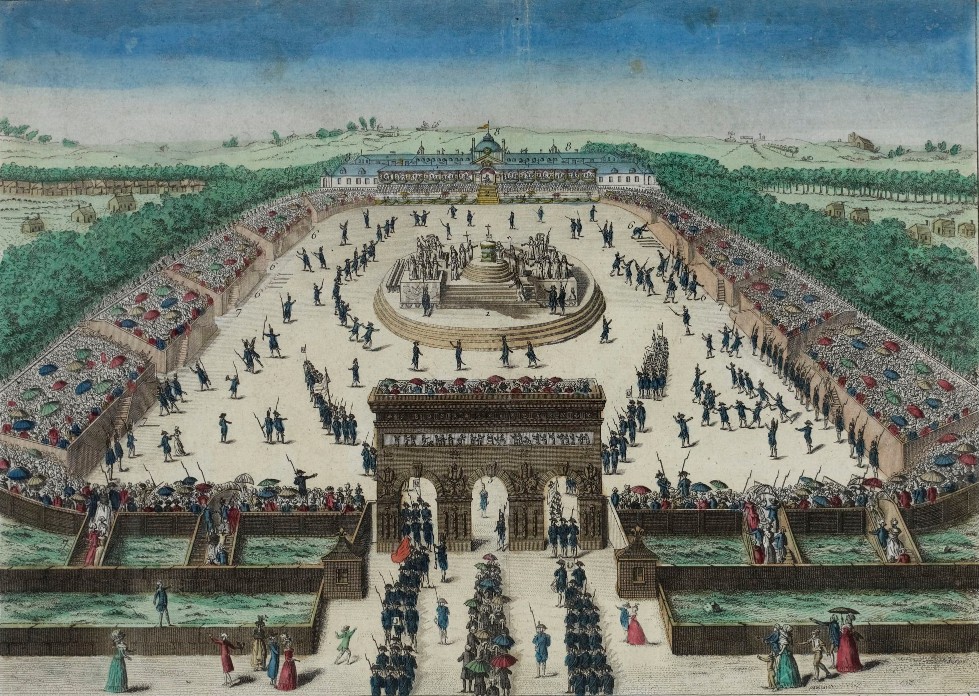
The Festival of the Federation was a massive event in Paris, in 1790, in order to celebrate the French Revolution. Anonymous image provided by the Museum of the French Revolution and licensed under CC BY-SA 4.0 DEED.

The first phase of the French Revolution alarmed Europe’s absolutist monarchies and turned a domestic constitutional crisis into an international conflict. They feared being overthrown and soon formed coalitions to fight the French revolutionaries. Meanwhile, the royal family attempted to flee to Austria, but Louis XVI was arrested and forced to ratify the Constitution of 1791. These events reinforced the Revolution’s instability and opened another phase, with major changes in politics, society, and economics.
2nd Phase: National Convention (1792-1794)
The National Convention marked the radical phase of the French Revolution, dominated by Jacobins with support from the Sans-Culottes. Peasants and urban workers were disappointed by delays in social reform and strongly opposed the counterrevolutionary actions of other European powers. Their revolutionary zeal grew, and radicalism followed both inside France and abroad.
Within France’s borders, the Gregorian calendar was replaced by the French Revolutionary calendar to remove religious and royalist influences. The new system first counted time from January 1, 1789, taken as the beginning of Year I and the Year of Liberty. In 1792, revolutionaries overthrew the monarchy, executed the royal family, and established a republic. The calendar’s first year was then reset to symbolize the Republic itself.
The National Convention was supposed to be a provisional government, and it was expected to relinquish its power and give it to a regular government. Nevertheless, this arrangement persisted for quite some time, and the Convention elaborated the Constitution of 1793, with the following highlights:
- Abolition of slavery in French colonies.
- Universal manhood suffrage.
- Land reform: redistribution of land, from wealthy landowners to the peasantry, without compensation for those who lost land.
- Free public education.
- Pensions for widows and orphans.
- Law of the General Maximum: a cap on the prices of goods and services. This measure was imposed on the government by the Sans-Culottes and it helped to ensure proper feeding of the urban population.
During this phase of the French Revolution, the Jacobins used the Reign of Terror to defend the republic through executions and repression under emergency government. Much of the bloodshed was carried out by the Committee of Public Safety, the body charged with protecting the new republic against foreign and domestic enemies. The Committee’s most notable leader was Maximilien Robespierre, who helped expand the killings even though he did not begin them. According to Eric Hobsbawm, indiscriminate violence was probably the only way to save the Revolution and perhaps even France itself as a country.
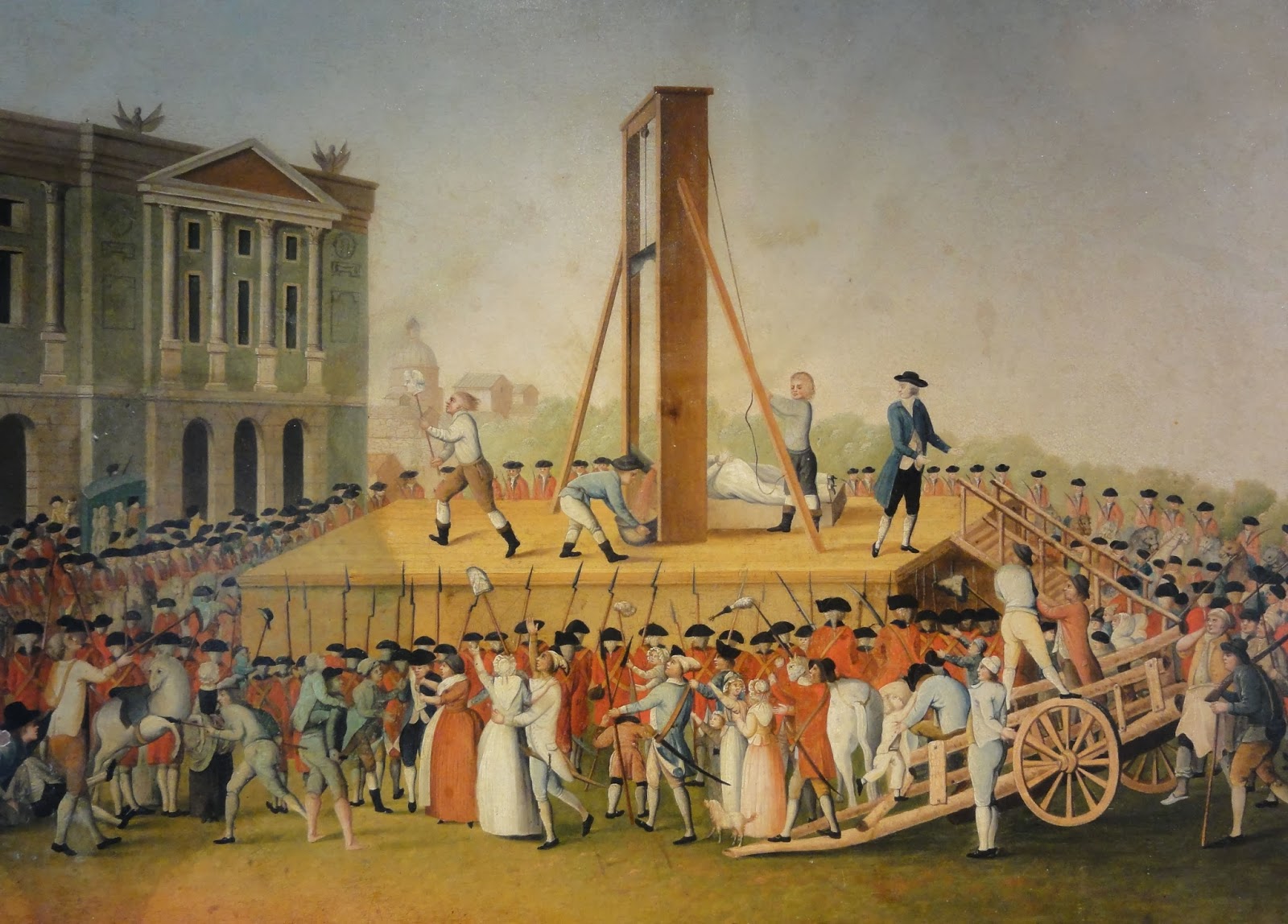
Execution of Queen Marie Antoinette by guillotine. Many similar executions followed. Image by unknown author, provided by Art Resource, in the public domain.

Internationally, France had to confront the absolutist monarchies of Europe, which built the First Coalition to suppress the Revolution. Both revolutionaries and counterrevolutionaries wanted war because both thought they could win it. At first, the revolutionaries won some battles and lost others. Later, the French army improved sharply and helped change the course of the conflict. Following a logic of total war, the French introduced conscription and treated every citizen as a fighter. The army also stopped rewarding its members by social rank. Meritocratic promotion allowed the best soldiers and officers to rise in the military career and lead their subordinates to further victories.
Thanks to the Army, France was able to halt the First Coalition. However, domestically, the situation was dire. In the midst of the Reign of Terror, the Jacobins split into two opposing factions. The Ultras under Jacques Hébert pushed for stronger repression measures than those already in place. They also campaigned for more measures against the interests of the Catholic Church. In turn, the Citras under Georges Danton were adamantly opposed to the Reign of Terror and wanted it to end completely. Robespierre viewed both factions unfavorably and implemented a purge against them, but this only made him be even more estranged from the Jacobins as a whole.
In the coup of 9 Thermidor, Girondin factions used the Jacobin split to take power in the Thermidorian Reaction. Robespierre and his partisans, meanwhile, were condemned to death by the Revolutionary Tribunal. They were executed at the Place de la Révolution, the same place where they had killed their enemies.
3rd Phase: National Directory (1794-1799)
This was the final phase of the French Revolution. It was a conservative period, in which politics was dominated by the Girondins with support from the Plain or the Marsh. At this time, the Girondins believed that Jacobin reforms had gone too far, threatening the stability of France. That is why the new government sought to undo much of what had been done before, and the promulgation of a new and entirely different Constitution exemplifies it. These were the highlights of the Constitution of 1795:
- End of universal manhood suffrage: Voting rights became, once again, restricted to those who owned properties. This meant that the masses were excluded from politics one more time.
- End of land reform.
- Reinstitution of slavery in French colonies: This encouraged enslaved people to rise up in Haiti, in the Caribbean, ultimately leading to independence.
- Establishment of a shared Executive Power: Power was shared by five directors, among which the Girondins prevailed. This fact explains why this phase of the Revolution was called the Directory.
- Establishment of a bicameral Legislative Power: the Council of Five Hundred was the lower house, while the Council of Ancients (or Council of Elders) was the upper house.
Even though the Reign of Terror came to an end, many common people were dissatisfied with the setbacks in social policies. The masses reacted under the leadership of the Sans-Culottes in the Conspiracy of the Equals to overthrow the Directory. Spearheaded by Gracchus Babeuf, this coup d’état aspired to install an egalitarian and proto-socialist republic inspired by Jacobin ideals. However, one of its leaders, Georges Grisel, denounced the movement and the government mounted a violent crackdown. Ultimately, the revolt failed.
Historians such as Michel Vovelle emphasize that domestic life under the Directory was marked by corruption and poverty as well as violence and instability. Amid that instability, the army gained political weight because it could suppress dissent at home and win victories abroad. Eric Hobsbawm argues that the soldiers lacked training and discipline as well as intelligence, supply and medical systems. Those weaknesses made quick victories necessary because the army had to offset its limits in organization and logistics. French troops stifled political dissent within the country and began to operate more effectively beyond its borders. They defeated foreign coalitions and toppled many neighboring absolutist regimes. Then they replaced them with sister republics controlled by revolutionaries. This process internationalized the French Revolution.
At this time, the government became increasingly dependent on the army, because military conquests helped finance it. In particular, Napoleon Bonaparte, a general who personally oversaw several French victories abroad, gained broad popular support. He eventually realized that the civil government was weak and dependent on military officials. In 1799, with support from politicians and intellectuals such as Emmanuel Sieyès, Napoleon seized power in the Coup of 18 Brumaire and brought the Revolution to an end.

“The Coup d’État of 18 Brumaire”, an engraving by Giacomo Aliprandi representing Napoleon’s seizure of power. Public domain image.
Conclusion
The French Revolution, alongside the Industrial Revolution, is one of the two most important revolutions in the 18th century. It started because the bourgeoisie wanted more political representation, to the detriment of the clergy and the nobility, which wanted to preserve their privileges. Following the storming of the Bastille, the Revolution took a more popular vein, even though the first revolutionary government was moderate. The Reign of Terror made those opposed to the movement shiver — both within France and outside it —, and the absolutist monarchies of Europe tried to quell the French, to no avail. Girondins reacted to Jacobin excesses in the National Directory, but the weakness of the government paved the way for the rise of Napoleon Bonaparte to power.
The Napoleonic Era preserved some experiences inaugurated by the French Revolution, but not all of them. Napoleon remained in power for many more years before being defeated in 1815 by the absolutist powers. The spirit of the French Revolution continued to influence revolts across the world. That was the legacy it left behind.