
Proclamation of the King of Prussia as the king of the newly-created Germany, at the Palace of Versailles, on French territory. Painting by Anton von Werner. Public domain.

Until the second half of the 19th century, Germany, as a single sovereign state, did not exist. Instead, Central Europe contained many small kingdoms and duchies, each with its own ruler; Bavaria, Hesse, Württemberg, Hanover, and Luxembourg are examples. Two larger powers, Austria and Prussia, had the territory and influence to dominate the others. German unification was the gradual amalgamation of these territories under Prussian leadership, in a process shaped by all the states of the region. Each had a role in the unification wars and in the military victories or failures that defined them.
Origins of the Unification
The Napoleonic Era gave German unification its first strong ideological impulse. For Napoleon, only two German resources usually mattered: men to bolster the French army and money to finance it. France therefore built a predatory relationship with local German elites and drew what it needed from the German peoples. This cooptation mechanism worked in the short term and helped form several shared traits among different German populations: hostility to France, nationalism, and militarism in defense of the homeland.
German identity was not uniform. Each population reacted differently to French exploitation, which is why it is possible to speak of nationalisms and militarisms in the plural. Yet hostility to the French, and not only to the Napoleonic regime, became a shared trait. It helped connect the region’s different identities: German peoples could differ in their immediate aims, but most of them, if not all, defined themselves in opposition to France.
At the end of the Napoleonic Era, the status quo in Central Europe had become unsustainable. There were a multitude of small states, generally weak and incohesive, which post-war architects saw as vulnerable to future French attacks. For the diplomatic representatives sent to the Congress of Vienna, it was essential to ensure an arrangement that consolidated the influence of the European powers and stabilized the Old Continent. Therefore, the Congress of Vienna created a German Confederation dominated by Austria and Prussia. Its role was to ensure that Central Europe would be more homogeneous and less vulnerable to French covetousness.
In political terms, there was greater German integration, through the Diet of Frankfurt (an arrangement among local monarchs), although Austria prevailed in it. Economic integration also increased, thanks to the advancement of the Zollverein, a customs union led by Prussian industry. Despite this, the region’s military strengthening — the cornerstone of the Vienna arrangement — did not happen right away. At that time, Prussia under Frederick William IV was modernizing its Armed Forces, developing them in a technical and scientific manner. However, Austria’s major security concerns were in the Italian Peninsula, where they had various strategic interests; and the other German states were too weak to proactively defend their own territories.
In the midst of the liberal revolutions of 1848, Prussia saw the creation of the so-called “Frankfurt Parliament”: an attempt to impose a constitution on the Prussian monarchy and unify the country with the other German kingdoms. The rebels were harshly suppressed by Frederick William IV, but their ideas would be reused later. Soon after, in 1849, based on the Frankfurt ideals, the monarch of Prussia proposed the unification of the German Confederation into a constitutional federation, led by him. Austria, which would be marginalized by this, turned against the proposal and warned the other states about Prussian hegemony in Central Europe. Through the Punctation of Olmütz, Austria and Prussia postponed war by agreeing to settle the Confederation’s future together.
Second Schleswig War (1864)
In the years following the Olmütz pact, facing a succession crisis in Denmark, the two German powers even attempted broader cooperation. The Duchies of Schleswig and Holstein had historical ties with the Germans but were personally linked to the Danish crown. However, with the death of the Danish monarch in 1863, his legitimate successor tried to bind both duchies institutionally to Denmark. This led Austrians and Prussians to consider the claim of another successor to the throne, who would be more favorable to German interests. However, the final response of the German Confederation was military and political: a deployment of troops to the duchies and an agreement between Austria and Prussia to define the region’s status.
The conflict that ensued upon the arrival of foreign forces in the Danish duchies is known as the “Second Schleswig War”. The war is often treated as the first war of German unification because it brought Schleswig and Holstein into the Confederation. According to the Gastein Convention (1865), Austrians and Prussians would share sovereignty over the duchies, but each of them would be administered separately.
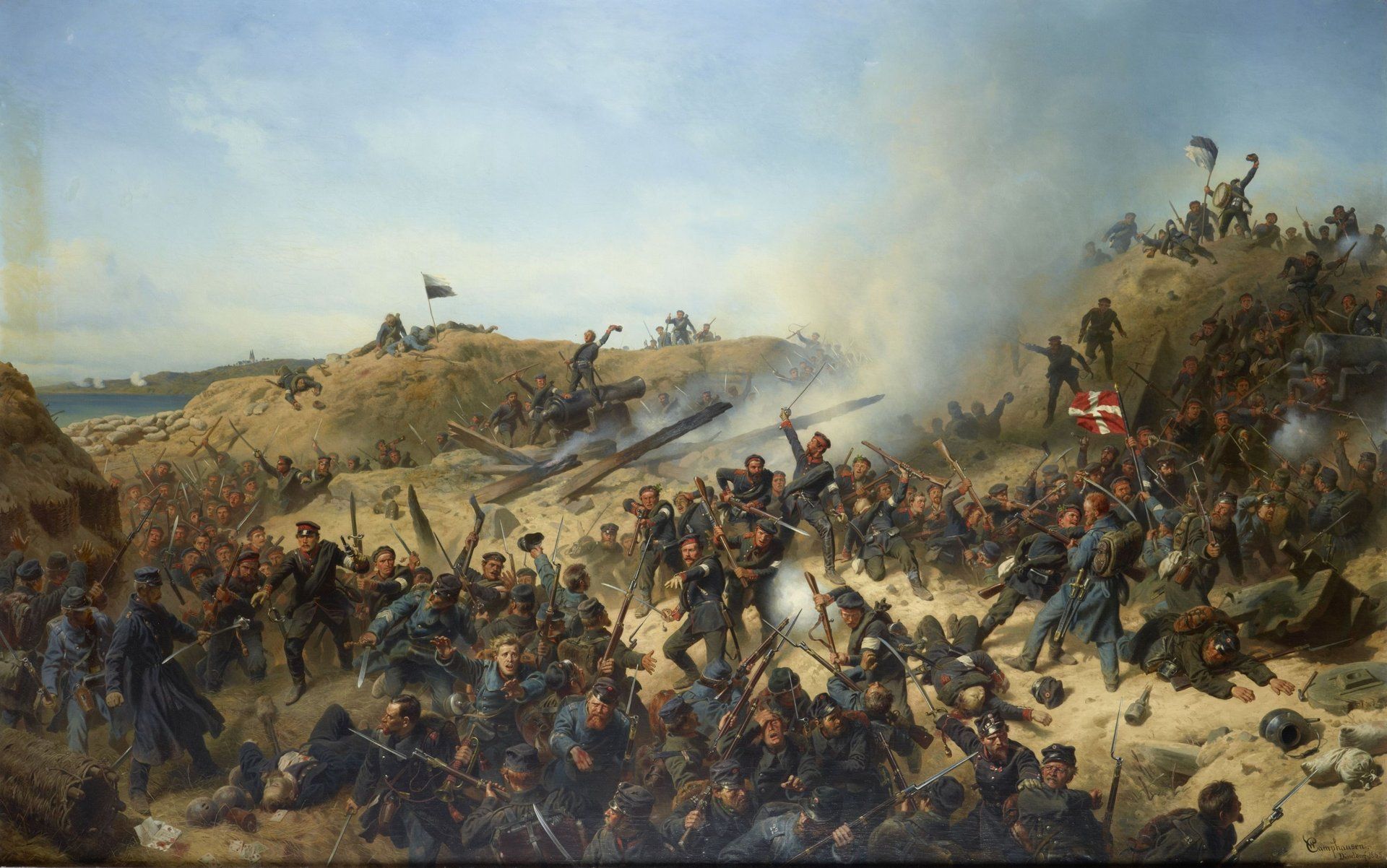
In the Second Schleswig War, Austrians and Prussians fought against Denmark to control Schleswig and Holstein. Painting by Wilhelm Camphausen. Public domain.

Austro-Prussian War (1866)
The cooperative spirit of the Gastein Convention concealed the continued tensions between the two German powers — after all, Austria increasingly felt threatened by a Prussia that was improving its Armed Forces and had major economic ambitions for the Zollverein. Similarly, the Prussian monarchy knew that its aspirations would challenge the Austrians.
After the Second Schleswig War, members of the German Confederation remained divided. Each German power sought international support to counter the other: Prussia aligned with newly unified Italy, while Austria reinforced its ties with the Southern German states. The catalyst for war came in 1866, when the Austrians denounced the actions of their rivals in the German Confederation and Prussia dissolved that association. As soon as Austria presented itself as the protector of the small German states against the supposed “Prussian aggression,” Otto von Bismarck, the Chancellor of Prussia, declared casus belli. Thus began the “Brothers’ War” (1866), the second German unification war, in Central Europe and Italy.
In the Italian Peninsula, Austria managed to fight relatively well, based on deadly confrontations that demoralized the Italians — mainly because this had been the main theater of operations for the Austrian forces for a very long time.
In the German theater of war, however, the situation was quite different. Prussia enjoyed all the technical, scientific, and military progress it had built in the previous decades. Its actions were organized, systematic, and extremely effective, partly due to a series of new weapons it possessed. On the other hand, Austrian deficiencies were evident: chaotic and demotivated troops were led by indecisive officers, who made wrong decisions and carried out problematic retreats.
In the Battle of Königgrätz, when the Austrians finally had a real chance to respond to their misfortune, it was already too late. Prussia won the war and imposed the creation of a North German Confederation, including the Northern German states and both Danish duchies, while reserving the power to define its relations with the Southern German states by force if necessary.
Austria, France, and the Search for Allies (1867-1870)
While Prussia dealt with the consequences of the 1866 war, which catapulted its power in European territory, the Austrians suffered even more. Due to the Compromise of 1867, the Austrian Empire became a dual monarchy, composed of Austria and Hungary.
Although some integration between the Armed Forces of these monarchies was expected to happen, in practical terms, the Hungarians were not willing to support any military initiatives in German territory. Because of this, the most Austria could do to counter Prussian power was an “in principle” alliance with France, which feared Prussian hegemony in Central Europe. The French statesman Napoleon III also established another “in principle” alliance with the Italian monarch Victor Emmanuel, in exchange for the withdrawal of French troops occupying Rome in defense of the Catholic Church.
Luxembourg, Spain, and the Ems Dispatch (1870)
Napoleon III wanted to rally Austria and Italy as allies because Prussia challenged several French interests. To accept recognizing the emergence of the North German Confederation, he proposed the French annexation of Luxembourg (an area occupied by the French) and Belgium — what was promptly rejected by Prussia. Instead, Bismarck called an international conference, where the powers of the Concert of Europe agreed to make Luxembourg a neutral territory, which meant a defeat for France.
Another problem arose with a succession crisis in Spain. A relative of the King of Prussia intended to ascend to the Spanish throne, but this could corner France between two domains of the Hohenzollern dynasty — Spain on one side and Prussia on the other. These issues propelled Napoleon III to make a declaration of war, but this was postponed several times, as France was at a disadvantage against a militarily sophisticated and modern Prussia.
The first attempt to resolve the Spanish succession crisis was peaceful: a French ambassador traveled to negotiate with the King of Prussia. Although the monarch committed not to support his relative’s claims to the Spanish throne at that time, his refusal to make this commitment permanent became a bone of contention. In the Ems Dispatch, the Prussian Foreign Minister reported to Bismarck how the meeting between the ambassador and the Prussian king occurred. However, Bismarck deliberately altered this report, making the words in it offensive to both the Germans and the French. By publishing the edited Ems Dispatch, Bismarck helped turn a diplomatic dispute into the Franco-Prussian War.
By that point, the dispute was no longer only about Spain. The Luxembourg setback had already shown Napoleon III that Prussia could frustrate French ambitions through European diplomacy. The Hohenzollern candidacy then made that frustration look like encirclement, while Bismarck used the French reaction to present the coming conflict as a defensive German cause.
War, Siege of Paris, and Treaty of Frankfurt (1870-1871)
Napoleon III treated the agreements with Austria and Italy as secure alliances, although they were only statements of intent. Prussia, by contrast, could combine its own troops with those of the other German states except Austria, which had advanced militarily under Prussian influence. The conflict therefore again set well-prepared forces against unprepared ones. France managed to repel some Prussian advances, but its technical weakness limited its ability to launch successful attacks. Its numerical superiority also failed to offset the precision of German armaments. In 1870, the Second French Empire collapsed after military defeats, a republic took its place, and Napoleon III became a prisoner of war.
Under the French Third Republic, however, the conflict persisted, and the coalition led by the Prussians reached the outskirts of Paris. The balance of forces had changed considerably. The French were on the defensive, with an enemy surrounding their capital, while the Germans had to hold positions inside France. German troops fought both Parisian resistance, symbolized by the Paris Commune, and resistance from rural French populations. This pressure led Prussia to bombard Paris to force a local surrender. The bombardment did not work at first, but peace negotiations eventually began under an obvious imbalance between the two belligerents.
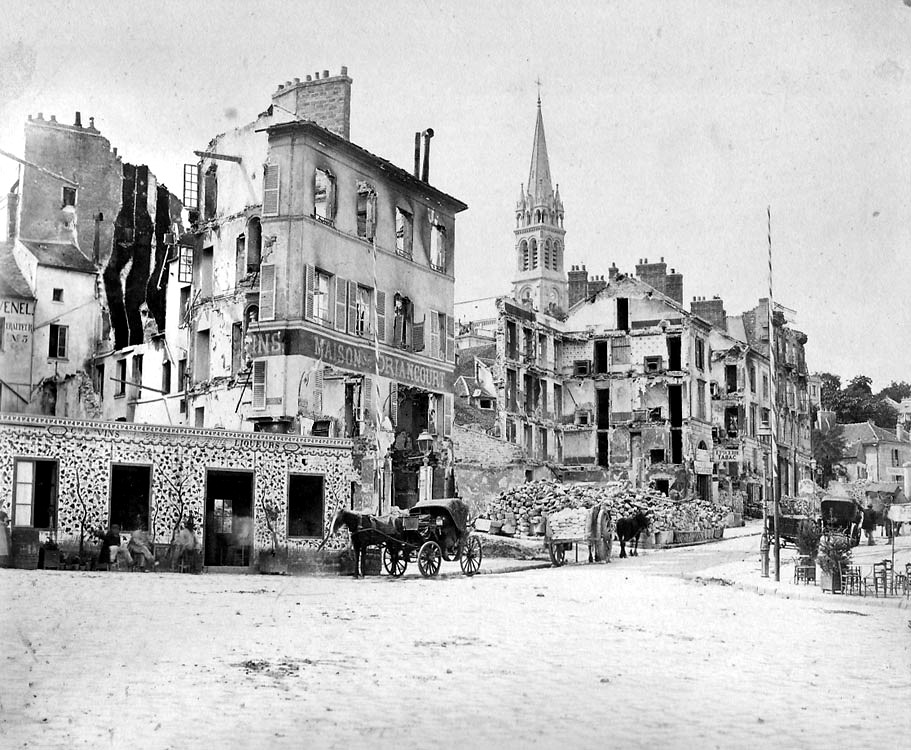
Photograph of the Saint-Cloud region, on the outskirts of Paris, after the bombings carried out by the Germans. Image by Adolphe Braun. Public domain.

At the end of the negotiations between the French and the Germans, the Treaty of Frankfurt made German unification official and imposed a punitive peace on France:
- German unification became official with the coronation of King William I of Prussia as the monarch of the new country.
- The Germans would annex the Alsace-Lorraine region.
- France was to pay war indemnities to the Germans, and would be militarily occupied until this debt was paid off.
- As a measure to reaffirm a defeat that, until then, was not accepted by the French people, a humiliating “victory parade” would take place in Paris.
This set of stipulations from the Treaty of Frankfurt would fuel, in the short and long term, Franco-German revanchism. While the French nation struggled to pay off its war debts and end the occupation of its territory, the Germans completed their process of integration and expanded their diplomatic activity, under the leadership of Bismarck. Yet the fallout of the war would remain latent in both states and, over the 20th century, would lead to new conflicts between them.
Conclusion
German unification came late, only in the second half of the 19th century. Once the wars began, however, the process moved quickly: it united dozens of small monarchies in only seven years.
After the founding of the country, Bismarck consolidated his power further and orchestrated an alliance between nobles (Junkers) and the bourgeoisie to industrialize the country. Domestically, German society was militarized, and the army held immense political prestige. In international relations, unified Germany tried to spread the idea that the country was satisfied with the status quo in Europe — in other words, that the Germans would avoid engaging in other wars. This was a deliberate strategy aimed at the international isolation of France.
Bismarck remained in power until 1890, balancing his country amid the European powers. However, after the death of King William I, the chancellor was forced to resign by the new monarch, William II, who wanted to impose a foreign policy based on territorial and military expansionism. Such was Bismarck’s influence on German political life that, after his withdrawal, the Germans had less success in securing their objectives on the international stage. The shift of Germany from moderation to militarism can be understood as one of the long-term causes of World War I.